

The 77th lecture in the Adventus Amicorum salon series was held on May 12, 2026, at the Institute of Country and Region Studies, Peking University (PKUICRS). Anastasia Pyatachkova, associate professor at the School of International Affairs, faculty of World Economy and International Affairs, HSE University, shared insights on the topic "Russia–China Academic Collaboration in the Context of Higher Education Reform in Russia." The lecture was moderated by Fei Haiting, a tenured associate professor at the School of Government, Peking University, with Yang Po, a tenured associate professor at the Graduate School of Education, Peking University, serving as the discussant.
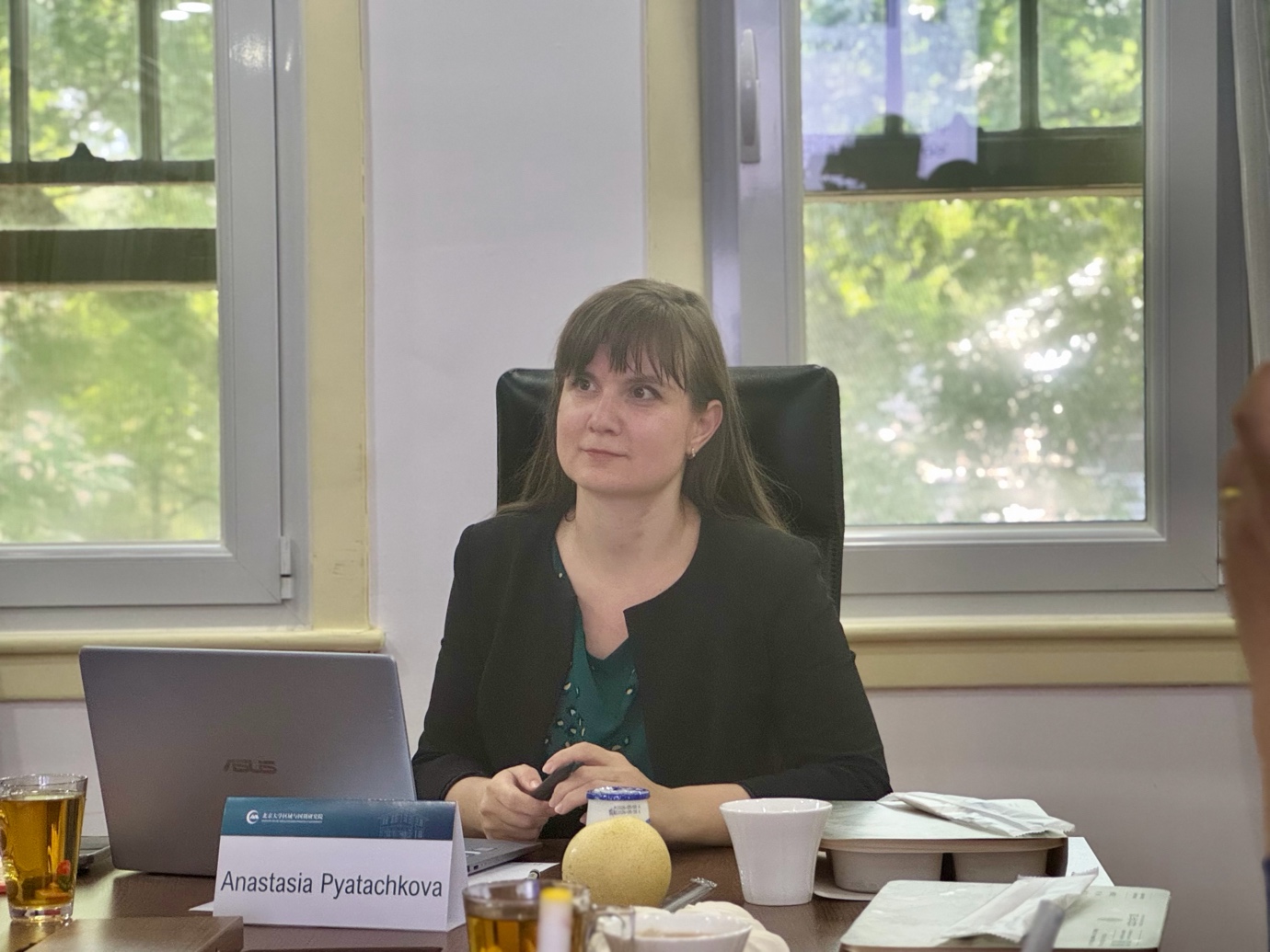
Prof. Pyatachkova’s lecture addressed three interconnected themes: the current state of HSE University’s cooperation with Chinese institutions, the shifting landscape of Russia’s international academic partnerships amid sanctions, and the ongoing comprehensive reform of Russia’s higher education system.
Prof. Pyatachkova opened with a profile of HSE University — one of Russia’s leading institutions, founded in 1992 and participating in the Priority 2030 program — and presented a detailed account of its collaboration with China. The university currently maintains 87 cooperation agreements with 55 Chinese partner institutions, participates in the BRICS university network, and conducts joint research projects with Peking University, Tianjin University, and other Chinese institutions. Approximately 300 Chinese students are enrolled at HSE, and Chinese language education is flourishing across the university’s faculties.
Turning to the impact of Western sanctions, Prof. Pyatachkova argued that Russia’s educational landscape has not become isolated but has instead undergone a strategic reorientation toward the Global South. Since 2022, new agreements have been signed with institutions in China, Uzbekistan, Kazakhstan, Brazil, Vietnam, and other countries. She noted that these shifts are reshaping the academic interests of Russia’s younger generation, with growing attention to the Global South and to Chinese studies.
The second part of the lecture focused on Russia’s higher-education reform. Prof. Pyatachkova identified several drivers, including the inadequacy of four-year bachelor’s programs in foundational disciplines, AI-driven technological disruption, economic pressures, and demographic challenges. The reform introduces a two-tier degree structure — basic professional education (4-6 years) and specialized professional education (1–3 years) — along with targeted employment contracts, deeper industry involvement in education, and mandatory national courses. Six pilot universities have begun implementation, and the full-scale reform is scheduled for 2030.
In closing, Prof. Pyatachkova reflected on the implications for Russia-China educational cooperation. She argued that the new model, though more country-specific, does not signal isolationism. Shared external pressures from Western nations create opportunities for deeper bilateral engagement, particularly in technology and sensitive fields. Russia’s pursuit of “technological sovereignty” is constrained by its technological limitations, making international cooperation — especially with China — indispensable. The 2026–2027 Russia-China Cross-Years of Educational Cooperation offers an additional framework for deepening this partnership.
In the discussion, Prof. Yang Po offered a systematic commentary on both academic cooperation and education reform. She highlighted the fragility of international academic partnerships and the dominance of state logic in shaping current collaboration patterns. Regarding education reform, she identified a pro-market and pro-industry orientation, observed a transition toward a higher-cost educational model, and emphasized the interconnection between education reform and broader strategic adjustments in research policy and social engagement between the two countries.
