

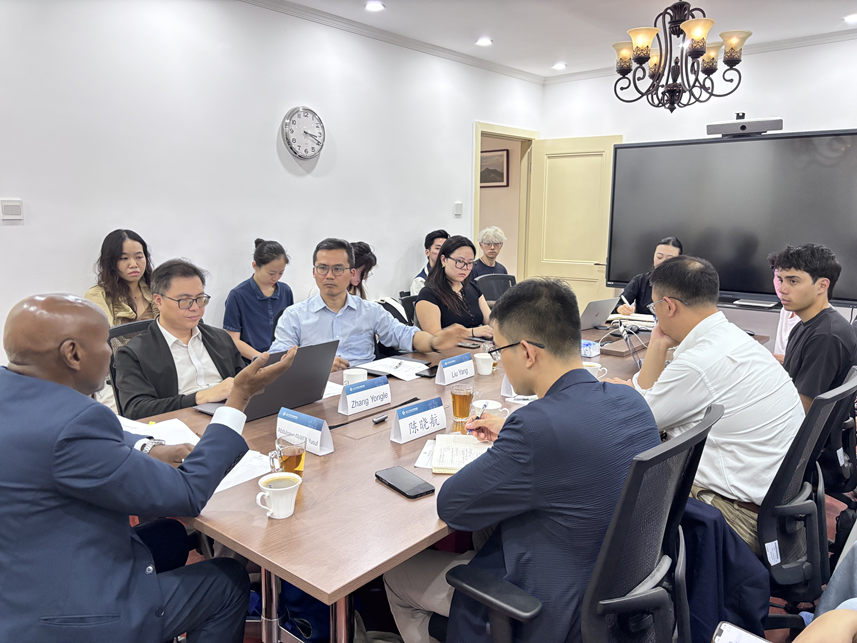
The 105th lecture in the “Adventus Amicorum” salon series was held on September 29, 2026 at No. 66 Yannanyuan, Peking University. Judge Abdulqawi Ahmed Yusuf, a Somali international law scholar and Founder and Director of the African Institute of International Law, delivered a lecture titled “International Law and Africa.” Zhang Yongle, tenured associate professor at Peking University Law School moderated the event. The discussants were Liu Yang, assistant professor at Renmin University of China Law School; Chen Xiaohang, assistant professor at Peking University Law School; and Du Zhonghua, Boya Postdoctoral Fellow at Peking University Law School.
Judge Yusuf began by emphasizing that the relationship between Africa and international law cannot be understood solely by examining the present; it must also be situated in its historical context. To understand international law as it exists today, he argued, one must first understand where it came from. In the nineteenth century, European powers used international law as an instrument of colonization in Africa and Asia and of oppression of African and Asian peoples. Yet contemporary international law is not simply the old international legal system accepted unchanged by Asian and African states. Judge Yusuf stressed that its transformation largely resulted from the long struggles of the peoples of Asia and Africa. These struggles began well before the Bandung Conference, and Bandung further consolidated the collective strength of Asian and African countries and provided an important foundation for their joint efforts to reform international law.
Judge Yusuf further observed that Western countries have frequently accused Asian and African states of human rights problems, whereas historically it was oppressed peoples struggling for their own liberation, freedom, and independence who stood at the forefront of the human rights struggle. Against this background, the African independence movement emerged, with Pan-Africanism serving as one of its most important intellectual foundations.
Tracing the origins of Pan-Africanism, Judge Yusuf explained that it was not merely an idea centered on a shared African identity but also a political practice closely linked to human rights, national self-determination, and anti-colonialism. It helped shift African peoples’ demands from property rights and self-government to the pursuit of national independence and political liberation. By the 1960s, most African countries had achieved independence, yet Pan-Africanism did not end. Instead, it evolved into an important intellectual foundation for institution-building across the African continent. Both the establishment of the Organization of African Unity and the later creation of the African Union can be understood within this historical trajectory.
Political independence, however, was not the ultimate goal of Pan-Africanism. As Kwame Nkrumah emphasized, political liberation had to come first, followed by economic and social liberation. Only after freeing themselves from colonial rule and achieving political independence could African countries pursue economic development and greater autonomy. From early Pan-Africanism to contemporary African integration, the central question has remained how African peoples can achieve not only political independence but also genuine autonomy and development across the economic and social spheres.
During the discussion, the three discussants engaged in an in-depth exchange with Judge Yusuf on the lecture’s themes. Liu Yang noted that it was particularly meaningful to consider the relationship between international law and modernity within the framework of area studies. The history of Africa and international law shows that industrialization and investment have often been intertwined with questions of security and spheres of influence. Without more stable security arrangements, the prospects for African development would remain uncertain. Political strategies concerning security, as well as the role of international law within them, are therefore of great importance. Liu observed that discussions of international law often take existing security structures as given, whereas more fundamental structural changes may ultimately be among the issues that African peoples need to confront. The history of international law in Africa and the political struggles surrounding it have been intertwined with questions of security since the early nineteenth century. He suggested that how this relationship will take shape and where it will lead in the 21 century remains an important question for further reflection.
Chen Xiaohang shared two observations. First, structural biases inherited from the colonial history of international law remain embedded in the international legal order today. It is therefore necessary to reflect on the colonial structures of international law and consider how to address biases that have clearly favored European and North American states. Second, he asked to what extent Third World Approaches to International Law (TWAIL) has been accepted within African international legal scholarship, and whether an intellectual approach developed largely within European and North American universities can fully articulate the perspectives of the Third World.
Du Zhonghua also raised two questions. First, how did African political elites educated in European colonial centers interact with those educated locally in Africa, and how did their understandings of international law differ? Second, what potential does international law, despite the colonial structures it continues to carry, have for addressing environmental issues closely intertwined with colonialism and neo-colonialism? Judge Yusuf responded in turn to each of these questions.
The lecture also drew students from various departments across Peking University. Participating students engaged Judge Yusuf in an extensive discussion of issues such as Africa’s right to development, the practical challenges of implementing the African Union’s principles, the language of international law, and how African solidarity might be reinvigorated in the contemporary era.
At the end of the lecture, Prof. Zhang Yongle thanked Judge Yusuf for an illuminating presentation and the faculty and students for their enthusiastic participation. He emphasized that Chinese and African scholars should continue to cooperate on these issues in at least three areas: the precolonial history of international law in Africa, the shared memory of anti-colonial struggles in Asia and Africa, and emerging practices of international law amid the rise of the Global South. He expressed hope that the lecture would serve as a starting point for deeper dialogue. The event concluded on a warm, hopeful note.
