

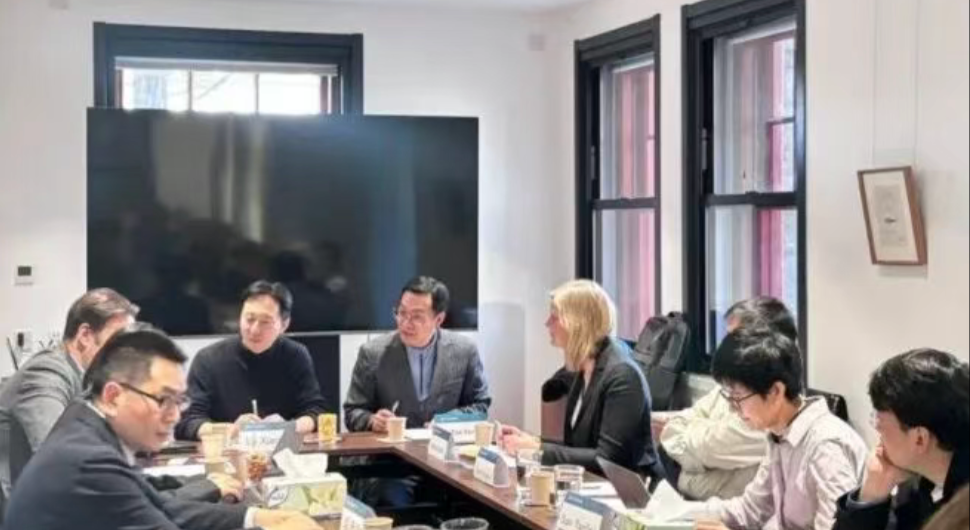
The 69th lecture of the “Adventus Amicorum” salon series was held on December 24, 2025 by the Institute of Area Studies, Peking University (PKUIAS), during which Dimitar Bechev, director of the Dahrendorf Programme at the European Studies Centre, St. Antony’s College, University of Oxford; and Janka Oertel, distinguished policy fellow of the European Council on Foreign Relations (ECFR), shared their thoughts on the topic, “Where to Go? China and Europe in a Time of Geopolitical Turbulence”. The lecture was co-moderated by Zan Tao, deputy director of PKUIAS, and Lu Xiaoyu, assistant professor at the School of International Studies, PKU. Other participants included Zhao Dingxin, dean of Zhejiang University Institute for Advanced Study in Humanities and Social Sciences; Zhang Yongle, deputy director of PKUIAS; Duan Demin, tenured associate professor in the Department of Political Science, School of Government, PKU; Sun Yanfei, tenured associate professor in the Department of Sociology at Zhejiang University; Zhang Biao, associate professor at the School of Political Science and Public Administration, China University of Political Science and Law; and You Mi, professor of Art and Economics at the University of Kassel.
The lecture lasted for three hours and was divided into two sessions, allowing for comprehensive and in-depth discussions among the attending faculty and students. In the first half, Bechev first introduced the Dahrendorf Programme. He then drew on his forthcoming book, The Scramble for Europe, to discuss the external challenges facing the European order from an international relations perspective, with a particular focus on Russia and Turkey. He argued that Europe’s regional order is unique. Today, Turkey and Russia pose distinctly different challenges to Europe. Turkey seeks to renegotiate its relationship with Europe as an equal, calling for enhanced security cooperation, collaborative defense projects, and a dynamic partnership free from the hierarchical dynamic of the past. The Russia–Ukraine conflict has also escalated tensions to a point where a return to pre-war relations is impossible, and efforts to pursue European strategic autonomy have been hampered by sanctions and military escalation. Finally, he outlined three strategies Europe could adopt in response to these challenges: a strategy of containment, a strategy of resilience, and a strategy of selective engagement.
Janka Oertel’s speech focused on China–Europe relations. She stated frankly that, from a European perspective, China–Europe relations are currently at their lowest point, with both sides pursuing de-risking measures, mutual suspicion deepening, and uncertainty overshadowing the decision-making process. On one hand, over the past decade, the China–Europe relationship landscape has undergone a dramatic reversal, but Europe has failed to adapt to this change, resulting in a sense of security much lower than it ought to be. This pervasive sense of insecurity has become a self-fulfilling prophecy in the minds of European policymakers, exacerbating tensions. On the other hand, China is Europe’s largest industrial competitor. China’s rise has not only impacted Europe’s traditional industries but also shaken Europe’s vision of remaining a global industrial power in the future. In this context, China’s rare earth export restrictions and other permanent export control measures might appear highly technical at first glance, but in reality, they constitute a direct challenge to Europe. What was initially an industrial issue has rapidly escalated into a pressing political concern, and the “China challenge” has become a significant policy focus across Europe. Current China–Europe relations can no longer be improved through dialogue or diplomatic visits as was usual in the past; Europe needs to embrace a multipolar world order. Although the outlook is bleak, the current crisis could also force Europe to become stronger, and a strong Europe would ultimately benefit both China and Europe.
In response to the speakers’ presentations, Duan Demin noted that China has consistently endeavored to maintain normal, constructive relations with Europe. China recognizes the extremely important role Europe plays in its vision of a multipolar world order. However, the core issue is that, for years, neither the US nor Europe has been able to view the world from the same perspective as China. The key point of divergence between China and the West lies in the perception of international norms: the US and Europe often advocate a set of universal values and rules, claiming their applicability worldwide. Yet, in practice, we have witnessed these major powers repeatedly taking unilateral measures to reshape other countries to suit their own interests. In contrast, China has consistently advocated mutual benefit, win-win results, and common development. A country that anticipates an independent, strong Europe and a better life for the Global South should not be seen as a “threat”.
Zhang Yongle argued that Europe’s prosperity has long relied on US security guarantees, Russian energy supplies, and the profits European companies made in the Chinese market. Currently, all three aspects are experiencing new changes. Many of the current dilemmas stem from the fact that while the EU has developed an awareness of strategic autonomy, its concrete practices in many areas still exhibit strong historical inertia. Furthermore, when placing new demands on China, it often fails to adequately recognize the negative impact its historical inertia has had on China. China and Europe need further coordination at the interest level, but more crucially, they require exchanges at the level of cognitive frameworks to enhance mutual understanding. Zhang Yongle particularly pointed out that European and Chinese civilizations have been shaped by different historical processes — namely, “competing states standing side by side” in Europe and “great unity” in China. Today’s European integration can draw lessons from the developmental trajectory of Chinese civilization, acknowledging and embracing the diversity of world civilizations, and promoting exchanges and mutual learning among civilizations.
Drawing on personal observations and insights, Zhao Dingxin suggested that Europe should contemplate how to transform its perceived crisis into a diplomatic approach based on rational dialogue grounded in realism and morality. The deep-seated mutual distrust among China, Europe, the US, and other countries is rooted in historical interactions. Diplomacy must take into account factors such as mutual misunderstandings, information asymmetry, and structural constraints to resolve these differences.
Zhang Biao engaged in an in-depth discussion with the two speakers on issues of inter-institutional coordination in European governance and Turkey’s role in Europe. Zan Tao shared his observations on the evolution of Turkey’s role and stance, particularly regarding its EU accession process and regional influence, noting that Turkey’s stance toward the EU has undergone significant changes: its EU accession process is largely stalled, and its current interactions with the EU are strategic rather than passive compliance.
Sun Yanfei proposed that the strategic realignment triggered by the Trump administration made China–Europe cooperation inevitable. Per Sun Yanfei, we must clearly recognize the deep interdependence between China and Europe. Both are core stakeholders in maintaining an open, rules-based globalization. If a consensus on interdependence can be reached, dialogue can be strengthened and differences can be proactively managed. Disputes should not be allowed to create divisions; instead, common interests should be leveraged to build new frameworks and mechanisms to sustain the process of globalization and safeguard a more stable and prosperous international order.
You Mi acknowledged that China and Europe had many different narratives about each other, but there were also many realistic possibilities; and that the two speakers had proposed sound pathways. When Europe participates as a whole in this competition, how to clearly identify what kind of friends it needs amid these complex narratives is a question worthy of European reflection, he said.
In the second half of the lecture, the two speakers responded to the above questions one by one and continued discussion with the attending faculty and students on topics including the impact of AI development on China–Europe–US relations; misalignments and constraints in China–Europe diplomatic interactions; industrial competition in sectors such as electric vehicles, photovoltaic panels, wind power, and biomanufacturing; and the significance of “Made in China” for improving the material living standards of the Global South. Both sides agreed that competition is inevitable but should be benign (healthy) competition. They advocated that China and Europe should focus on practical interests and achieve complementarity within the global industrial chain. The cognitive differences between China and Europe need to be resolved by increasing academic exchanges and people-to-people interactions, avoiding biases driven by media narratives, and jointly promoting win-win outcomes in areas where each has comparative advantages.
