

On July 3, 2026, the 101st session of the “Adventus Amicorum” seminar series, organized by the Institute of Country and Region Studies at Peking University and titled “Central Asian Studies and the Issue of Universality,” was held at No. 66 Yannanyuan, Peking University. The keynote speaker was Prof. Mirzokhid Rakhimov, director of the Center for Contemporary History of the Academy of Sciences of the Republic of Uzbekistan. Prof. Rakhimov’s research combines perspectives from history and political science, addressing questions such as the national-territorial delimitation of Central Asia in the 1920s, the transformation of regional and international relations among the Central Asian states, and the reconstruction of historical memory and the shaping of collective identity in the post-Soviet space. The seminar was chaired by Shi Yue, tenured associate professor at the School of Foreign Languages, with commentary by Zan Tao, professor in the Department of History and deputy director of the ICRS.
The lecture unfolded in three sections: the conceptualization of Central Asia within world history and culture; the region’s role in civilizational interconnectivity and diplomacy; and the nation-building process, regional cooperation, and the current state of Central Asian studies. Prof. Rakhimov urged scholars to move beyond narrow ethnocentric historiographies and to reinterpret Central Asia’s historical standing through lenses of cross-civilizational interaction and global exchange.
In the first section, he explained that “Central Asia” is fundamentally a natural-geographical space rather than a political community defined by ethnicity, language, or religion. Successive labels, including Turon, Māwarāʾannahr, and “Central Asia,” reflect successive reconstructions of knowledge systems and political orders. Contemporary researchers should be wary of projecting modern notions of ethnicity and the nation-state onto the past.
In the second part of his lecture, Rakhimov emphasized Central Asia’s pivotal role in civilizational interactions across the Eurasian continent. Drawing on Andre Gunder Frank’s theory of the “Centrality of Central Asia” and S. Frederick Stars’s account of Central Asia as a global intellectual hub, he noted that the Silk Road transmitted not only goods but also knowledge, technology, and ideas, and that Central Asia consequently gave rise to intellectual traditions of world significance. Central Asian scholars such as al-Biruni compared different civilizational traditions and cross-checked historical sources, embodying a scholarly spirit that transcended ethnic and regional boundaries and constituting an important historical practice of the idea of “universality.”
In the third part, focusing on the development of modern and contemporary Central Asia, Rakhimov analyzed the Tsarist Russian period, the “Great Game,” state-building during the Soviet era, and nation-state building after independence. In his view, the Soviet-era national-territorial delimitation shaped Central Asia’s modern state system while leaving a legacy of unresolved problems. Meanwhile, mass and higher education, along with industrialization, were major achievements of that period. Regarding post-independence nation-building, he argued that one should be alert to ethnocentric tendencies in historical narratives and insist on evidence-based historical research.
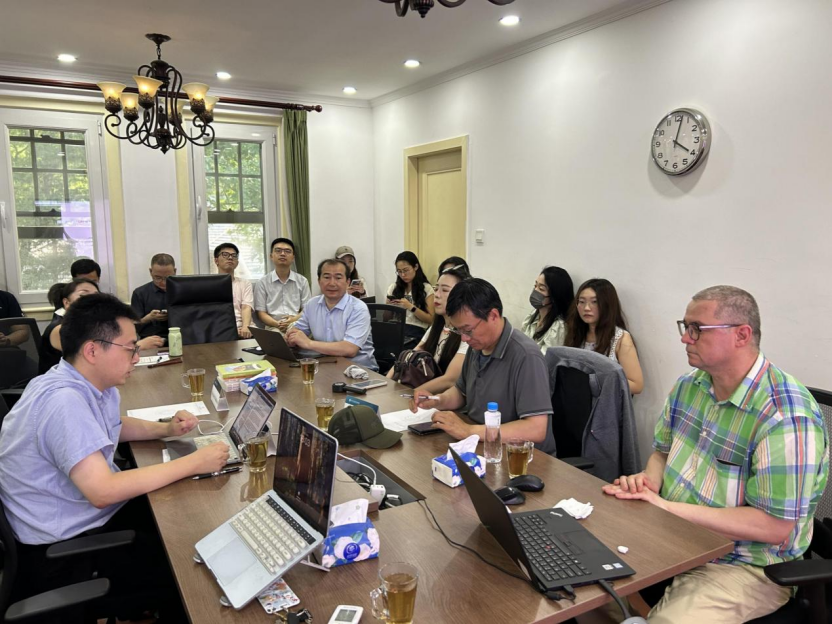
Speaking to the prospects for Central Asia’s development today, Rakhimov focused on new trends in regional cooperation in recent years. He noted that since 2017, high-level mutual visits, economic and trade cooperation, and people-to-people exchanges among the Central Asian states have deepened steadily, and that regional cooperation is gradually becoming an important driver of the region’s development. However, compared with cooperation on the ground, transnational collaboration within the field of Central Asian studies remains insufficient, and joint research, joint publication, and exchanges among young scholars will need to be further strengthened to move area studies in a more open and pluralistic direction.
During the discussion, faculty and students raised questions about the centrality of Central Asia, religious revival, script reform, regional cooperation, and international academic collaboration in the context of the Belt and Road Initiative. Rakhimov observed that the history of Central Asia is, in essence, a history of cross-civilizational exchange and that openness, plurality, and mobility have always been the region’s historical keynote. He concluded that contemporary Central Asian studies should maintain an interdisciplinary perspective and respond to the practical needs of regional development through comparative research and international cooperation, thereby rethinking, within the framework of global history, Central Asia’s historical position and contemporary significance in civilizational interactions across Eurasia.
