

The 84th lecture of the “Adventus Amicorum” salon series was held on May 29, 2026, at the Institute of Country and Region Studies, Peking University (PKUICRS). Cristina Patriota de Moura, Professor and doctoral supervisor in the Department of Anthropology at the University of Brasília, presented her research in a lecture titled “Anthropourbanistic Perceptions and Metropolitan Dynamics in Brasília.” The lecture was chaired by Zhang Fan, tenured associate professor in the Department of Sociology at Peking University, and featured contributions from three discussants: Roberto Malighetti, professor of Anthropology at the University of Milano-Bicocca and visiting scholar at the Institute for Advanced Humanistic Studies; Min Xuefei, associate professor in the School of Foreign Languages at Peking University; and Zhang Qingren, professor at the School of Ethnology and Sociology at Minzu University of China. The event also drew faculty members and students from various institutes and schools.
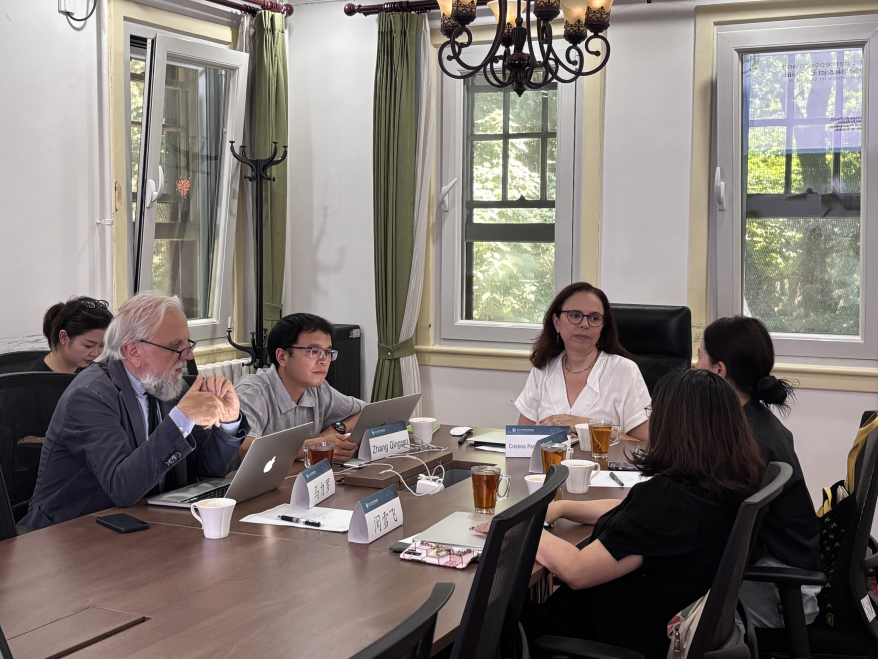
Cristina’s research focuses on the middle class and urban development in central Brazil. Her lecture centered on Brasília, a UNESCO World Heritage city, and examined the gap between its original planning ideals and the urban reality. She introduced the “Superquadra,” or “super-block,” as the basic residential unit of Brasília: buildings are raised on pillars to keep the ground level open; there are no surrounding walls; shops are placed between blocks rather than inside them; and every four super-blocks share a public school built within the community. This design embodied a distinctly egalitarian vision: “the minister’s son and the driver’s son will study in the same school.”
Yet Cristina pointed out that this vision has run into a profound paradox in practice. As apartments in the central planned area have become among the most expensive in Brazil, the public schools there are now attended almost entirely by children from low-income families in the surrounding satellite towns, many of whom face a one-way commute of more than an hour and a half. Meanwhile, middle-class residents in the area tend to send their children to private schools elsewhere in the city to secure a better education. This has created a growing gap between how the space is used and what its planners originally intended.
The lecture’s core ethnographic material comes from Christina’s team, an interdisciplinary group of anthropologists, historians, and urban planning scholars. The research found that students attending school in the planned area showed little interest in the heritage value of the surrounding super-blocks and were largely unaware of what the neighborhood looked like. Yet they could accurately identify bus routes and the way home beyond the block. These contrasting attitudes toward spaces inside and outside the planned area revealed markedly different ways of experiencing the city. For these children, understanding the city was grounded not in heritage narratives but in the embodied knowledge gained from navigating the metropolis daily.
At the close of the lecture, Cristina screened a short documentary produced by her research team. The film follows children from Ceilândia as its narrators, capturing, through their daily commutes and city journeys, how they understand, perceive, and experience a city shaped by grand planning and heritage designation. It offers a vivid ethnographic window into the themes of spatial perception, mobility, and urban life discussed throughout the lecture.
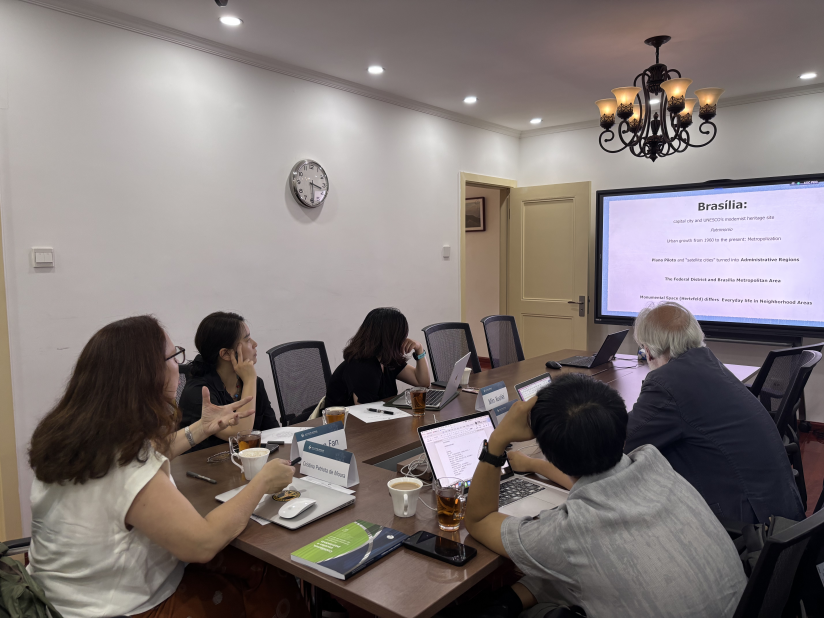
During the discussion, Min Xuefei shared her impressions and reflections on Brasília. Roberto Malighetti used the term “complexity” to describe the research’s methodological richness and to explore the tension between Brasília as a “utopia” and as a place where people live. Zhang Qingren drew on the anti-gentrification movement in Mexico City to discuss fairness and justice in urban space and compared the cosmological imagery embedded in Beijing’s traditional nickname, “the Eight-Armed Nezha City,” with the planning ideas behind Brasília. Zhang Fan, meanwhile, examined the relationship between urban planning and urban growth by drawing on the urban construction philosophies, historical evolution, and heritage-making processes of various cultural regions across China.
