
From May 10 to 23, 2026, at the invitation of the Institute of Country and Region Studies at Peking University, Prof. Punchada Sirivunnabood, dean of the Faculty of Social Sciences and Humanities at Mahidol University in Thailand and a professor of political science, visited the Institute as a visiting scholar under the “Country and Region Studies in a Global Context and Inter-Regional Knowledge Partnership” program. During her visit, Punchada delivered three keynote presentations as part of the Institute’s “Adventus Amicorum” seminar series. The 76th “Adventus Amicorum” lecture, on May 11, focused on “Constitutional Cycles and Institutional Reforms in Thailand and Indonesia”; the 79th lecture, on May 18, centered on “The ASEAN Security Architecture: The Evolutionary Logic of a Political-Security Community”; and the 80th lecture, on May 21, explored “The Political–Economic Drivers of Transboundary Haze in Southeast Asia and Regional Governance.” Lectures 76 and 79 were primarily aimed at undergraduate students from Peking University’s School of International Studies, School of Foreign Studies, and other departments who have a basic understanding of Southeast Asian political systems, with an emphasis on foundational knowledge. Lecture 80, however, was designed for Southeast Asian researchers with existing regional research experience and featured more in-depth discussions.
The three seminars invited numerous scholars to participate in the discussions, including Prof. Zhai Kun, deputy director of the Institute of Country and Region Studies at PKU; Kong Tao, director of the Research Department at the Institute of Social Science Survey, PKU; Prof. Song Qingrun of Beijing Foreign Studies University; Jin Yong, tenured associate professor at the School of Foreign Studies, PKU; and Richard Yarrow, research fellow at Harvard Kennedy School. The event also drew faculty and students from Tsinghua University, Beijing Foreign Studies University, and other institutions.
In Lecture 76, Punchada began with a comparative analysis of the political systems of Thailand and Indonesia. As a constitutional monarchy, Thailand nominally holds general elections every four years, but in modern history the country has experienced approximately twenty military coups. Each coup has typically been accompanied by the suspension of the constitution, the adoption of an interim charter, and the drafting of a new constitution, creating a cyclical pattern of constitutional restructuring. Indonesia is considered the most democratic country in ASEAN, holding regular elections and offering citizens ample space to participate in the development of political parties. Regarding the electoral system, Thailand’s current Senate is not elected through direct elections but is selected through nominations by professional groups, a practice rarely seen elsewhere. Indonesia, on the other hand, operates a presidential republic, with the president elected directly by the people. Its “Big Bang” model — holding presidential, parliamentary, and local elections on the same day — reflects a systemic logic that is starkly different from Thailand’s.
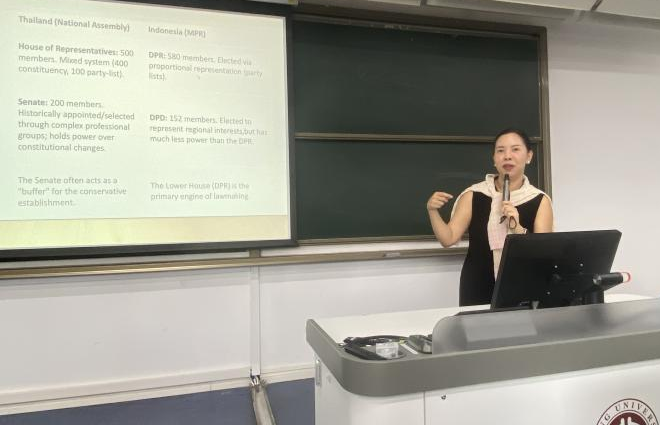
Punchada went on to analyze the distinct political dilemmas facing Thailand and Indonesia. She argued that Thailand stands at a crossroads in its democratic development, where vote-buying is widespread in constituency-based elections and where candidates, once elected, seek to recoup campaign costs through corruption, creating a vicious cycle. Meanwhile, the recurring pattern of Thai youth parties being dissolved only to reemerge reflects deep-seated challenges within Thailand’s political system. In Indonesia, the focus is on the trade-off between political continuity and the health of democracy. Indonesia’s current president, Prabowo, has largely continued the “big tent” style of coalition governance pursued by his predecessor, Joko Widodo, incorporating most major political parties into the government. While this model ensures political stability, it also weakens the opposition and risks sliding toward “competitive authoritarianism.”
In Lecture 79, Punchada examined the issue from multiple perspectives, including religion, political systems, social structures, and stages of development. She noted that ASEAN member states differ significantly across these areas and that to understand ASEAN and its governance challenges, one must first grasp the “diversity” of Southeast Asia. She also noted that while the European Union (EU) has strong institutional constraints and unity, with its member states required to meet numerous strict conditions, ASEAN places greater emphasis on national sovereignty, political diversity, and the principle of “non-interference in internal affairs.” Given these fundamental differences, simplistic comparisons between the two should be avoided.
Building on this foundation, Punchada analyzed the formation of the ASEAN Community. Since 2015, ASEAN has gradually transitioned from a traditional regional organization to a “three-pillar” community framework, advancing the ASEAN Political-Security Community (APSC), the ASEAN Economic Community (AEC), and the ASEAN Socio-Cultural Community (ASCC). Specifically, the Political-Security Community focuses on regional security and political coordination; the Economic Community emphasizes regional economic integration; and the Socio-Cultural Community centers on education, cultural exchange, and youth cooperation.
Punchada noted that to understand contemporary ASEAN, one must not view it as a monolithic entity; rather, one should examine the institutions and cooperative mechanisms that constitute each community separately.
On security issues, Punchada noted that ASEAN’s security agenda has gradually shifted from traditional military security to non-traditional concerns such as terrorism, cyber fraud, piracy, human trafficking, drug smuggling, and transnational organized crime. She highlighted the severe problem of cross-border telecommunications fraud and cybercrime in Southeast Asia in recent years. She noted that the region’s complex border structures and limited governance capabilities of Southeast Asian nations, coupled with some local governments being linked to criminal networks through corruption, make it difficult for these countries to effectively combat these issues. Punchada believes that the recent cooperation between the Chinese and Thai governments to combat telecommunications fraud has yielded significant results. Therefore, for certain non-traditional security challenges, effective cooperation with major powers outside the region often proves more practical and enforceable than coordination within ASEAN itself.

Lecture 80 offered an in-depth analysis of the structural obstacles to regional governance, focusing on transboundary haze pollution. Drawing on her long-term field research on the Indonesian island of Sumatra, Punchada argues that the haze problem in southern Thailand is not the result of a natural disaster but a structural environmental crisis caused by the expansion of Indonesia’s palm oil industry, the improper development of peatlands, the failure of local government governance, and the intertwining of transnational capital with local power networks. Since the Suharto era, the Indonesian government has promoted the expansion of palm oil plantations through land development policies, resulting in the drainage and reclamation of vast swathes of peatland and leaving the ecosystem extremely vulnerable. To reduce land-clearing costs, companies often hire local residents to clear land using slash-and-burn methods. Because of complex patronage relationships among local governments, businesses, and local political elites, such illegal activities are typically difficult to regulate or punish effectively.

At the regional governance level, Punchada highlighted the development of the ASEAN Agreement on Transboundary Haze Pollution. Although ASEAN had been pushing for the agreement as early as 2002, its implementation was long delayed by Indonesia’s failure to complete ratification. It was not until around 2016, driven by sustained pressure from countries such as Singapore and domestic policy adjustments in Indonesia, that regional cooperation made significant progress, leading to some relief from haze across the relevant nations. However, she also noted that ASEAN’s institutional principles of “consensus” and “non-interference in internal affairs” inherently limit its capacity for governance. This is particularly evident in complex border issues involving countries such as Myanmar and Laos, where coordination is even more difficult to establish.
Looking back at the three lectures — ranging from a comparative analysis of Thailand’s and Indonesia’s constitutional systems to the institutional logic of the ASEAN Political-Security Community, and finally to the governance challenges underlying cross-border haze — Punchada focused her discussion on Southeast Asia’s “diversity,” highlighting both the commonalities and differences among regional nations in political transition, security cooperation, and environmental governance. During the interactive sessions of the three lectures, participating faculty and students engaged in discussions on topics including anti-corruption mechanisms, research methods in comparative politics, “ASEAN resilience” and the “ASEAN Way,” China’s experience with air pollution control, and the challenges and significance facing ASEAN.
Following the conclusion of the 80th “Adventus Amicorum” lecture on May 21, the Institute hosted a appreciation ceremony for Punchada. Prof. Zhai Kun praised Punchada’s research, noting that her combination of multi-track diplomatic practice with transnational field research methods not only revealed the fundamental tension between “diversity” and “executive capacity” in ASEAN regional governance but also provided important insights for knowledge sharing and policy dialogue between Chinese and Southeast Asian scholars.