

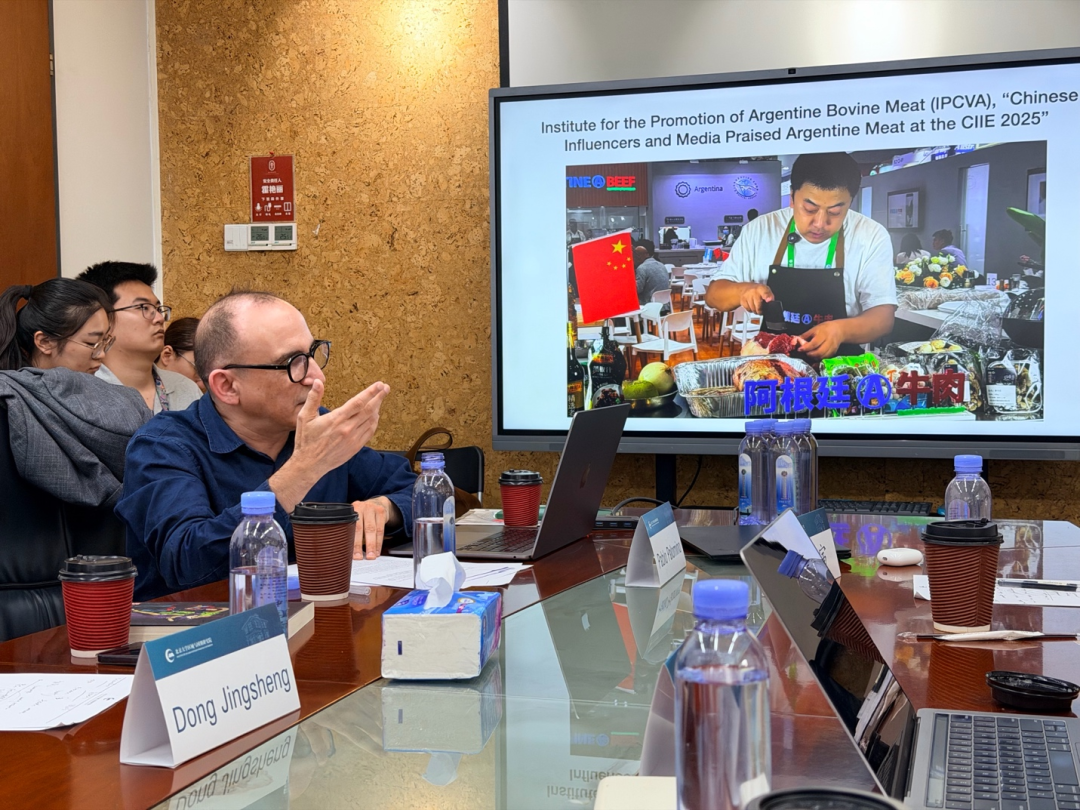
On June 12, 2026, the 92nd lecture in the “Adventus Amicorum” salon series was jointly organized by the Center for Latin American and Caribbean Studies and the Latin America Research Division of the Institute of Country and Region Studies, Peking University (PKUICRS). The speaker was Pablo Palomino, Associate Professor of Latin American and Caribbean Studies at Oxford College of Emory University, who presented a talk titled “The Global History of Argentine Beef.” The lecture was moderated by Guo Jie, tenured associate professor at the School of International Studies, Peking University. The discussants were Dong Jingsheng, professor at the Department of History, Peking University; Cao Yin, tenured associate professor at the Department of History, Peking University; and Yuan Mengqi, assistant research fellow at the Institute for International and Area Studies, Tsinghua University.
Prof. Palomino is a specialist in the cultural history of twentieth-century Latin America and the author of The Invention of Latin American Music: A Transnational History. In recent years, his research has broadened from the history of music to the global history of food consumption. In his lecture, he traced the global commodity of Argentine beef from its entry into the British market in the late nineteenth century and examined how it formed complex, durable entanglements with the markets and powers of Britain, the US, and Asia throughout the twentieth century. His talk unfolded along three main lines.
First, Argentine beef may be regarded as something approaching a “total social fact” in the anthropological sense. It is at once an everyday domestic consumer good and a commodity destined for the world market; at once an economic resource and a powerful symbol of political order, social life, and cultural identity. These four dimensions are deeply intertwined, profoundly shaping the nation’s economic policy, social structure, and foreign economic relations. At the same time, beef has always been shaped by modernity: from improvements in cattle breeds, ranch management, and slaughtering systems, through the reshaping of the international meat trade by refrigerated shipping and ocean transport, to the contemporary challenge that cell-cultured meat poses to traditional animal husbandry, the history of Argentine beef concerns not only past trade and consumption but continually points toward the many “futures” embedded within it.
Second, Argentine beef also serves as an important lens for observing shifts in the world order. It links the port trade and livestock exports of the late colonial Río de la Plata, the British-dominated international meat market from the late nineteenth century onward, the entry of American meatpacking capital in the twentieth century, and the rise of the Chinese consumer market in the twenty-first. The rise of Buenos Aires as a port city, the fusion of the ranch economy with political power in the Rosas era, and the reshaping of the spatial scale of the meat trade by refrigerated shipping together propelled Argentine beef, step by step, toward the heart of the world market. Using the 1930s Smithfield Market in London and the Roca–Runciman Treaty as case studies, Palomino revealed the institutional concessions Argentina made to maintain its exports to Britain and the deep entanglement among export-oriented development, the interests of the cattle elite, and the structure of international power. Prebisch’s later thinking on the “center–periphery” relationship took shape precisely within this historical experience.
Third, contemporary China’s trade and an ethnographic case study of the Hong Kong market present a new form of the global history of Argentine beef in the twenty-first century. After t World War II, Argentina’s relative advantage in the world market gradually declined amid competition from Australia, the US, and Brazil. Over the past decade or so, rising Chinese demand has injected fresh momentum into its exports. Unlike Britain’s deep embedding in Argentina’s meat economy during the first half of the twentieth century, China reshapes the export structure primarily through the market power of demand. The practice in Hong Kong kitchens of bridging the gap between frozen and chilled through a slow, controlled thaw is a micro-level illustration of a “two-tier global beef economy” that spans both mass and premium consumption. Palomino closed on the pun of steak and stake: Argentine beef is both a steak on the world’s table and this nation’s “share” and “stake” in the global economy.
In the discussion, Cao Yin, speaking from the perspective of South Asian studies, explored the political implications of beef consumption in Asian societies, the critical role of China’s “cold-chain revolution” in the global circulation of meat, and the long-underestimated environmental costs of the global cold-chain system. Yuan Mengqi, drawing on the context of the Milei government’s reforms, analyzed the tensions among domestic beef prices, export policy, and national identity in Argentina. Dong Jingsheng, proceeding from the logic of capital and the structure of the world economy, further discussed the market forces behind Argentina’s current beef exports and related environmental concerns. Palomino thanked the discussants for their comments and offered his responses.
