

The 76th lecture in the “Adventus Amicorum” salon series was held on May 11, 2026, at the Institute of Country and Region Studies, Peking University (PKUICRS). Punchada Sirivunnabood, dean of the Faculty of Social Sciences and Humanities and professor of Political Science at Mahidol University, Thailand, delivered a lecture titled “Constitutional Cycles and Political Reform in Thailand and Indonesia.” The lecture was introduced by Zhai Kun, deputy director of ICRS and professor at the School of International Studies, PKU, and concluded by Song Qingrun, professor at Beijing Foreign Studies University. The event also drew faculty and students from Tsinghua University, China Agricultural University, and Beijing Foreign Studies University.
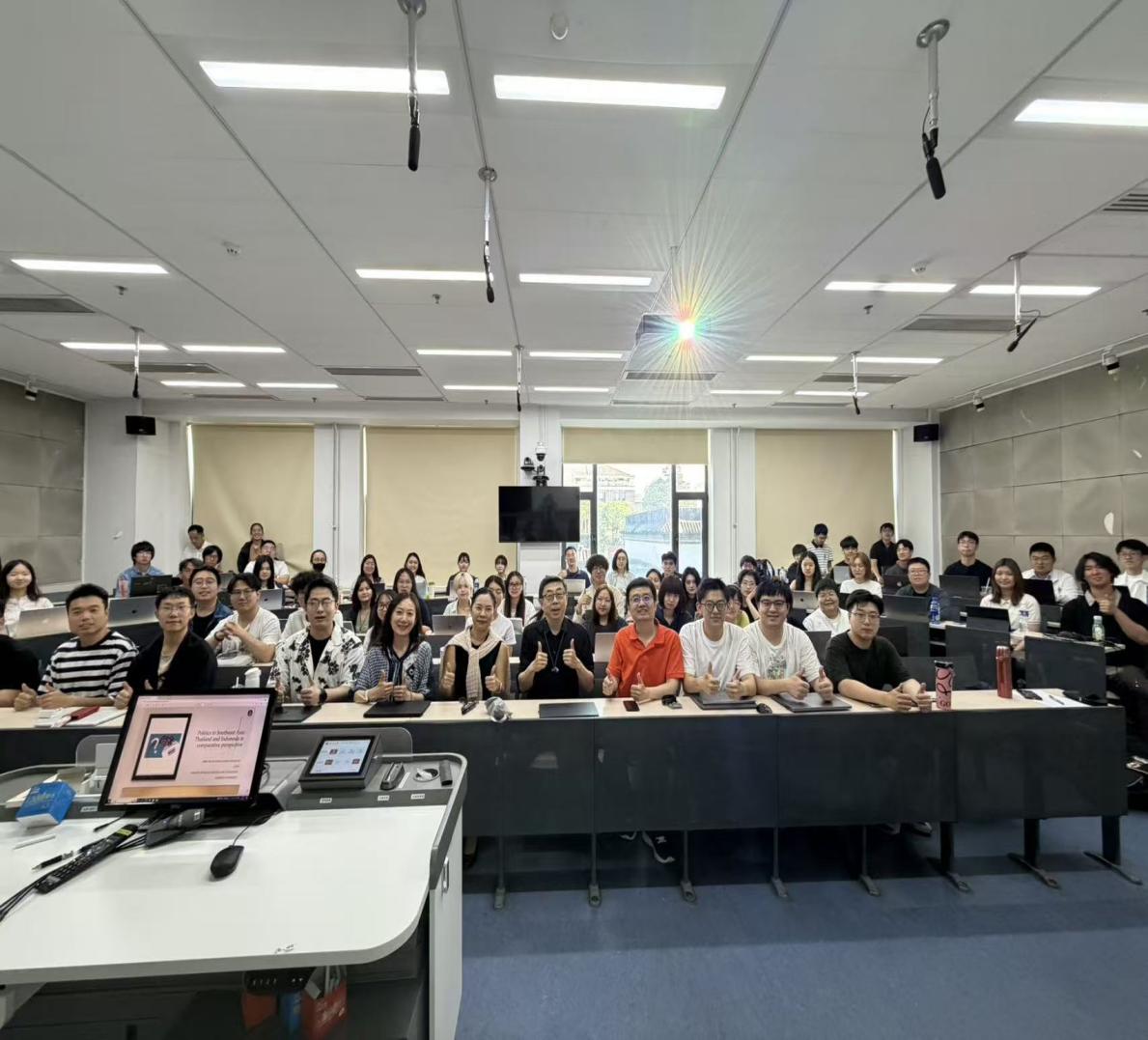
First, Punchada offered a comparative analysis of the political systems of Thailand and Indonesia. As a constitutional monarchy, Thailand is nominally required to hold general elections every four years. However, its modern history has seen approximately twenty military coups. Each time, the existing constitution was scrapped and a new one drafted, producing a recurring cycle of constitutional reconstruction. Indonesia, by contrast, is widely regarded as the most democratic state in ASEAN, holding regular elections and providing considerable space for civic participation in party politics. Regarding electoral institutions, Punchada highlighted that Thailand’s current Senate is not directly elected but nominated by occupational groups, a system virtually unique in the world. Indonesia operates as a presidential republic, with the president directly elected by the people. Its distinctive “Big Bang” election model, in which presidential, parliamentary, and local elections are held on the same day, reflects an institutional logic markedly different from Thailand’s.
Punchada then turned to the distinct political challenges facing each country. She argued that Thailand stands at a democratic crossroads: after years of military-backed constitutional governance, a 2026 referendum showed that over 65 percent of Thai voters supported drafting a new constitution. The current political contest is unfolding primarily between the People’s Party and the conservative establishment, represented by the Proud Thai Party and the Pheu Thai Party. By contrast, Indonesia’s central tension lies in the trade-off between political continuity and democratic health. President Prabowo has largely followed his predecessor Joko Widodo’s “big tent” governing style, absorbing most major parties into his coalition. While this approach has ensured political stability, it has weakened the opposition and raised concerns about a drift toward competitive authoritarianism.
Punchada concluded by examining three interrelated political phenomena common to both countries: vote buying, corruption, and the rise of youth political movements. She observed that vote buying is pervasive in Thailand’s elections. Once elected, candidates are expected to recoup campaign costs through corrupt practices. Decorative road fixtures and perpetually unfinished museum projects are two recurring methods of extracting public funds. She also assessed the current distribution of political power in Thailand, the influence of party factions, and the divergent political orientations among young Thais. She argued that the repeated dissolution and rebirth of youth-oriented political parties reflect a deep structural impasse within Thailand’s political system.
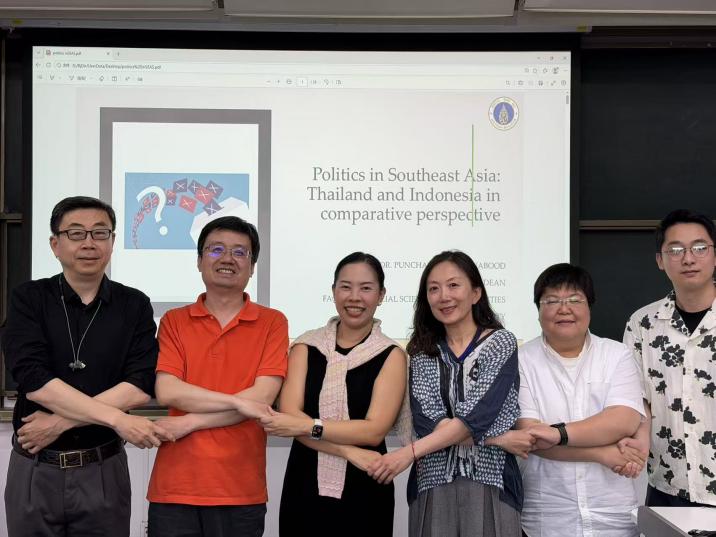
During the discussion session, Punchada engaged with faculty and students on topics including anti-corruption mechanisms, youth employment, and methodological approaches in comparative politics. Song Qingrun and Kong Tao, director of the Research Division at the Institute of Social Science Surveys, PKU, delivered closing remarks.
