

The 103rd lecture in the Adventus Amicorum series, titled Living in Update Mode: Updatism, Obsolescence, and the Politics of the Present, was held on September 17. The lecture was delivered by Prof. Valdei Lopes de Araujo and Prof. Mateus Henrique de Faria Pereira, both history professors at the Federal University of Ouro Preto, Brazil. It was chaired by Prof. Wang Yuan, an assistant professor at the School of Foreign Languages, Peking University, with Guo Jie, a tenured associate professor at the School of International Relations, Peking University, and Zhou Yichuan, Shuimu Tsinghua Scholar at the Institute for Advanced Study in Humanities and Social Sciences, Tsinghua University, serving as discussants.
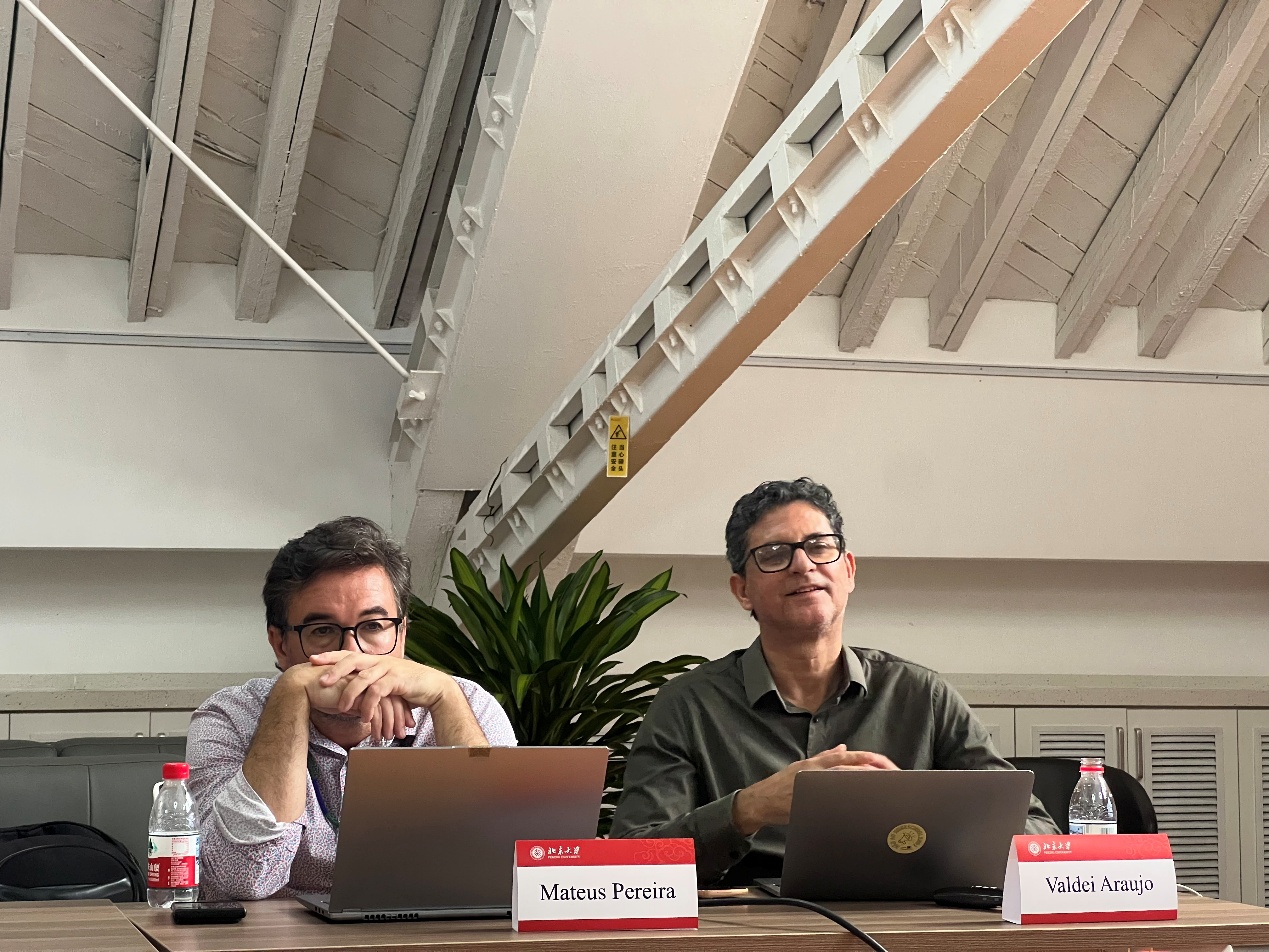
The keyword in Prof. Araujo’s lecture was “updatism,” a concept drawn from the consumer electronics industry that describes the prevailing social practice of maintaining compatibility and relevance between things and a changing environment through constant updating. The professor emphasized that updating does not mean “progress” and even lacks “direction.” People live in a constant state of anxiety about becoming out of date. Prof. Araujo sought to critique the Western-dominated model of temporality in the contemporary world and, from the perspective of a historian in the Global South (particularly Brazil), to explore a new way of understanding historical time.
The concept of updatism stems from a simple observation: the word update has become extraordinarily pervasive in everyday language. People not only update their phones and computers but also databases, professional skills, and even themselves. The primary historical question, therefore, is how this word became so common. What does its spread reveal about the peculiar temporal cycle of our era? The currently prevalent language of updating—devices, skills, the self, and so on—became widespread from the mid-20th century onward, with the development of information technology. Yet this is not merely a lexical phenomenon; it reflects a specific structure of historical time. A similar trajectory can be observed in Portuguese, with words such as atualizar (i.e., to update).
The lecture’s core argument centers on distinguishing the “current” from the “present.” Prof. Araujo illustrated this by arguing that slavery cannot be confined to the past because its consequences remain active in society—as evidenced by contemporary racial conflict. This shows that some old things can be more current than new ones. Updatism tends to equate relevance and compatibility with “presence.” Prof. Araujo offered examples from Brazilian politics to show how “updating” becomes a neutral tool that can even be deployed for anti-democratic purposes. “Updating” itself does not mean “progress.” The 1970s saw the popularization of television, the development of satellite communications, and the entry of the space race into popular culture, all appearing to ride a wave of technological and modernizing updating—yet this coincided with the most violent phase of the military dictatorship.
On this basis, Prof. Araujo introduced the concept of “critical updating” to distinguish it from mainstream updatism. Mainstream updatism tends to equate relevance and compatibility with “presence,” so that only things conforming to current technological standards or social tempo are considered valid. By contrast, critical updating advocates introducing elements of the past or possibilities of the future into the present, thereby challenging and deconstructing the established order. This perspective emphasizes that history is not linear progress; the past has not truly passed but continues to act on the present.
Prof. Araujo’s lecture drew more than ten faculty members and students from Peking University and Tsinghua University, as well as staff from Xinhua News Agency. The professor then held a discussion with students and teachers on topics including Brazil’s contemporary political predicament, the manifestations of updatism in China, and alternatives to updatism.
