

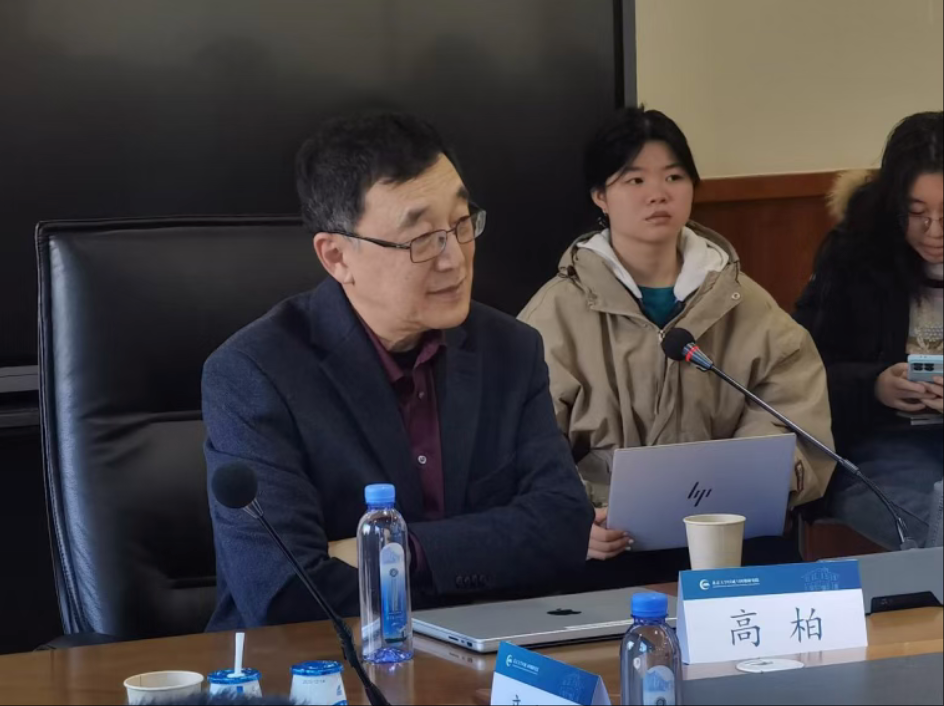
The 17th session of the Master Salon series hosted by the Institute of Area Studies, Peking University (PKUIAS), was held on December 23, 2025. The seminar was titled "The Rise and Fall of the Liberal International Order: Examining Trump's Strategic Adjustments Through the Lens of Historical Institutionalism." The salon invited Prof. Gao Bai from the Department of Sociology at Duke University as the keynote speaker, and was moderated by Zhang Yongle, deputy director of PKUIAS and tenured associate professor at the School of Law, PKU. Other participants included Lei Shaohua, associate professor at the School of International Studies, PKU; Guo Jie, tenured associate professor at the School of International Studies, PKU; Duan Demin, tenured associate professor at the School of Government Management, PKU; Feng Kaidong, professor at the School of Marxism of Tsinghua University; Ou Shujun, professor at the School of International Studies of Renmin University of China; Yang Meng, assistant professor at the School of Foreign Languages, PKU; and Ge Xiaohui, assistant research fellow at the Institute of Chinese Borderland Studies of the Chinese Academy of Social Sciences.
Prof. Gao Bai pointed out that the recent US National Security Strategy represents the most profound adjustment to American foreign strategy since World War II, as it undermines the US-led liberal international order established in the post-war era. From the perspective of historical institutionalism, he reviewed the evolution of the international order from the post-war liberal framework toward a trend of multipolarity, with a focused analysis on why the current Trump administration seeks to abandon the liberal international order.
Prof. Gao Bai began by discussing the impact of the US’s long-term asymmetric cooperation with its allies at the international level on its own global strategy. The dollar’s role as a key currency has granted the US the unique position of a liquidity provider. However, in the post-World War II era, the US supported its allies’ substantial exports while permitting them to adopt protectionist measures against American goods. Simultaneously, the US voluntarily restrained its own exports in exchange for allies’ support in political and defense domains, resulting in significant trade deficits that have become a severe economic burden.
Next, Prof. Gao Bai analyzed how the Trump administration opposed the establishment. Following World War II, the National Security Council Document 68 gained prominence after the Korean War, leading to a surge in US defense spending. The military-industrial complex that took shape after WWII has made it difficult for the US government to balance the trilemma of taxation, defense expenditures, and social spending, ultimately resulting in a fiscal predicament characterized by high debt. Currently, the resurgence of isolationism represented by the MAGA movement echoes the strategic adjustments of the Trump administration, reflecting the conflict between grassroots forces and the establishment in American politics. However, the recent split within the extreme right wing of the MAGA camp on the issue of Israel could have profound implications for the 2028 US presidential election.
In his conclusion, Prof. Gao Bai interpreted Trump’s strategic adjustments as a response to the increasingly unsustainable burdens, both domestically and internationally. Trump’s vision for the international order ultimately returns to the principles of sovereign supremacy, non-interventionism, and the balance of power inherent in the Westphalian system, departing from the liberal international order characterized by the active promotion of democracy and human rights abroad and assertive interventionism that the US has upheld since World War II. Currently, the structural conditions underpinning the liberal international order have undergone fundamental changes, including the persistent widening of the US trade deficit and debt burden, the gradual erosion of the dollar’s dominant status, a relative decline in military superiority, and the redefinition of national security by domestic political groups. Collectively, these shifts have driven the Trump administration’s strategic adjustments, expanding their scope from the traditional military and defense domains to broader areas such as culture and social structure, reflecting a response to profound changes in the international landscape.
During the discussion, Feng Kaidong argued that the new US National Security Strategy might be merely a stopgap response to pressures at home and abroad, rather than a blueprint reflecting any long-term strategic trend. From a science policy perspective, he also called for a re-examination of the boundaries for scientific funding under the Trump administration. Ou Shujun contended that the US relationship with the world has historically cycled through three phases — nationalism, imperialism, and cosmopolitanism — and has now returned to a period of nationalist dominance. Consequently, China must reconsider its role within the international system against the backdrop of rising conservatism. Duan Demin concurred with the observation that the Trump administration’s strategy marks a return to Westphalian principles, adding that this shift implies moving away from foreign interventions justified by universal human rights and toward a sharper focus on material interests. Lei Shaohua juxtaposed the science and technology innovation goals of China’s 15th Five-Year Plan with the Trump administration’s tech policies, suggesting that the expansion of China’s manufacturing sector and the strategic retrenchment of the US will likely forge a new dynamic of interaction and competition. Participants also discussed topics such as illegal immigration, the digital economy, the strategic intentions of US allies, and the metrics for assessing national security.
In his concluding remarks, Prof. Zhang Yongle pointed out that Prof. Gao Bai’s analysis, undertaken from the perspective of historical institutionalism, offered an analytical framework for understanding how international-domestic interplay has shaped US foreign strategy. The discussion touched upon many critical issues, including technological advancement, industrial innovation, partisan politics, and adjustments in the international system. Such an approach, he noted, will prove highly beneficial to fellow scholars in conducting further research on US foreign strategy within their respective disciplinary domains.
