

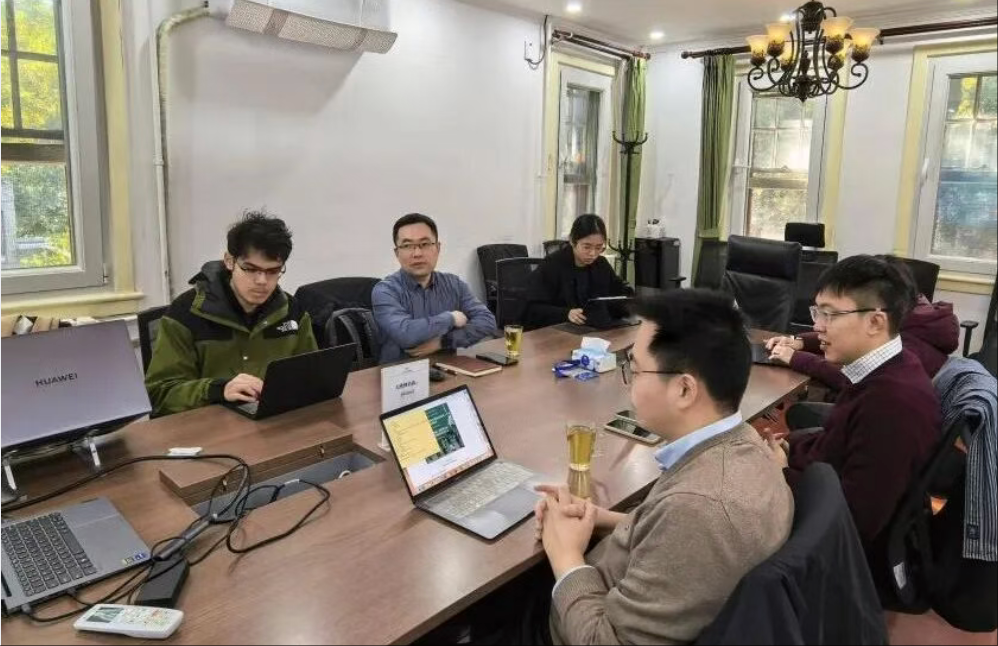
The 16th lecture in Youth Salon series hosted by the Institute of Area Studies, Peking University (PKUIAS) was held on November 2, 2025. It examined the conceptual and theoretical issues surrounding early modern Chinese and Western empires by analyzing specific historical cases labeled as empires.
The event featured Ning Ya, a lecturer from the School of History, Renmin University of China, and Wu Xunxiang, an assistant professor from the Law School of Peking University, as keynote speakers. It was moderated by Shi Yue, a tenured associate professor from the School of Foreign Languages at Peking University, with postdoctoral research fellow Li Pai from PKUIAS serving as discussant.
Ning Ya, in his presentation titled “Public Celebrations, Historical Narratives, and Ethnic Identity in Hungary during the Austro-Hungarian Empire Period,” conducted a case study centered on the 1896 Hungarian Millennium Celebrations. He focused on how, in the late 19th century, Hungary utilized and interpreted medieval historical resources for nation-state-building. Through specific practices, such as the preparation of celebrations, the reconstruction of urban spaces, and the compilation of general history works, he argued that the ethnic identity of the Hungarian political and cultural elites under the Austro-Hungarian dual-system exhibited both nationalist and imperialist characteristics.
He pointed out that the chosen year for the 1896 Millennium Celebrations and the dating of the Hungarian conquest of the Carpathian Basin were both constructed outcomes. As part of the celebrations, Hungary held a national exhibition, initiated the construction of landmark buildings including the Hungarian Parliament Building, and reshaped the public spaces of Budapest. Additionally, the Hungarian authorities organized the compilation of a ten-volume History of the Hungarian Nation.
From Ning’s perspective, the Millennium Celebrations served as a concentrated expression of the historical consciousness and ethnic identity among Hungarian elites during the Austro-Hungarian period. On one hand, they proclaimed the continuity of Hungarian ethnic history and territorial sovereignty, while on the other hand, they were imbued with a sense of “Great Magyarism,” asserting Hungarian superiority over neighboring ethnic groups.
Wu Xunxiang delivered a presentation titled “The Legal Expression of the Feudal Imperial System: Centering on the Peace Treaty of Westphalia,” analyzing the governance logic of the Holy Roman Empire from a legal-history perspective. He emphasized that the Holy Roman Empire was an empire under a feudal system, whose core characteristic was the co-governance between the emperor and the imperialestates, rather than being a sovereign state in the modern sense.
The rise of local estates in the 14th century allowed grassroots entities to form self-governing organizations through assemblies, which shook the traditional feudal system and reflected a trend toward decentralization in governance. The imperial reform movement promoted by the Habsburgs in the 15th century, despite attempting to strengthen centralization by establishing institutions such as the Reichstag and the Reichskammergericht, ultimately failed to achieve genuine power integration due to constraints from the privileges of the electors and the nobility.
The sectarian conflicts triggered by the Lutheran Reformation in 1517 were temporarily alleviated by the principle of cuius regio, eius religio (‘whose realm, their religion’) established in the 1555 Peace of Augsburg. However, underlying tensions persisted and eventually escalated into the Thirty Years’ War.
Based on this, Wu Xunxiang elaborated on the core significance of the Peace Treaty of Westphalia in 1648. In religious terms, it recognized the full equality between Protestantism and Catholicism, established the year of 1624 as the benchmark year for the restoration of ecclesiastical properties, and applied the “Ecclesiastical Reservation” principle equally to both sides. In political terms, it clearly defined the rights of territory and alliance for the various imperial estates. The Peace Treaty of Westphalia definitively eliminated the possibility of the Holy Roman Empire transforming into a centralized monarchical state, while simultaneously excluding the Roman Catholic Church from participation in the European international order. This promoted the initial formation of a “European sovereign state order.” The semi-sovereign status of the imperial estates became a key clue for understanding the transition from a fragmented feudal Europe to its modern sovereign state system.
During the discussion session, the participating scholars engaged in an in-depth dialogue on core differences in imperial governance between China and Europe, as well as the interactive relationship between historical narratives and political identity. They further refined two central issues in empire studies. First, how political entities referred to as “empires” understood and shaped communities, essentially addressing the balance between centralization and fragmentation. Second, how later generations used concepts, theories, or academic paradigms related to “empire” to reinterpret European imperial history since the Middle Ages, thereby reflecting on the suitability between theoretical frameworks and historical practices.
