

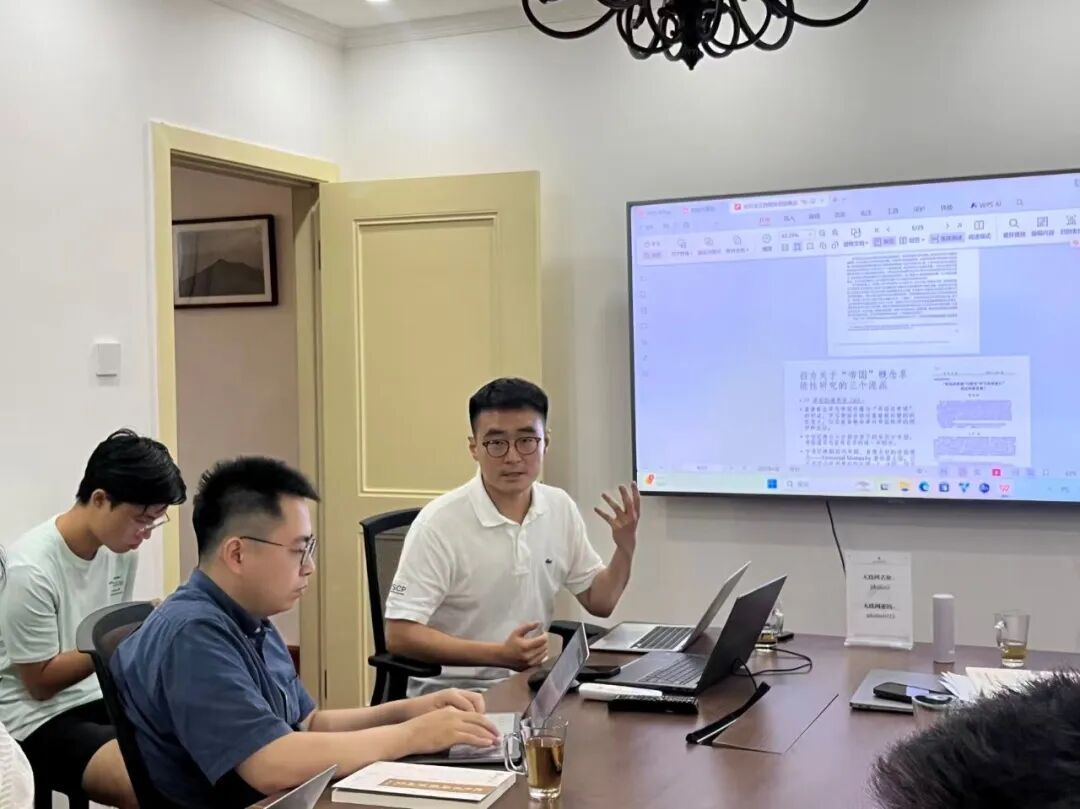
The 15th lecture of the Youth Salon series hosted by the Institute of Area Studies, Peking University (PKUIAS) was held on September 7, 2025. The theme of the salon was “Cannons and Cross: Expansion and Ideology Building of Modern Western Colonial Empires.” The keynote speakers were Postdoctoral Fellow Jiang Yang and Lecturer Liu Qingyuan from the School of History, Capital Normal University. The discussion panel included Prof. Pang Guanqun from the School of History, Beijing Normal University; Ning Ya, lecturer from the School of History, Renmin University of China; Li Limin, research fellow from the Institute of Ethnology and Anthropology, Chinese Academy of Social Sciences; Shi Qing, postdoctoral fellow of PKUIAS, and PhD student Gao Chengyuan from the Department of History, Peking University. The session was moderated by Associate Professor Shi Yue from the School of Foreign Languages, Peking University.
The salon unfolded in two sessions. In the first session, Jiang Yang delivered a presentation titled “The Cross on the Crown: The Catholic Church and the Expansion and Rule of the Spanish Empire.” He analyzed the symbiotic relationship and inherent tensions between the Catholic Church and the imperial expansion of Spain. Beginning with the sculpture “Four Kings Bearing the Tomb of Christopher Columbus” in Seville Cathedral, Jiang Yang set the background of the fragmented Christian world during the 15th and 16th centuries, a period where Spain emerged as the primary defender of the Roman Catholic Church. The Papacy provided religious legitimacy for the empire’s territorial expansion, while Spain contributed military power and trans-oceanic capabilities.
At the level of colonial governance, religious orders acted as the vanguard of imperial frontier expansion through learning indigenous languages, forming alliances with local leaders, and advancing spiritual conquest. In contrast, the secular clergy functioned akin to state bureaucrats, with churches serving as community centers. Local priests oversaw matters of marriage and funerals, and also took on roles in informal lending and education. However, this collaboration harbored underlying tensions. The core dispute centered on the conflict between the Church and the Crown over the protectorate of missions, which encompassed the right to collect tithes and appoint bishops. By the 18th century, when the Bourbon Dynasty implemented secularizing reforms, these long-accumulated contradictions ultimately erupted, leading the Church to turn against the Crown and becoming a significant driving force in accelerating the empire’s disintegration.
Pang Guanqun commenced her analysis by examining the ambiguity and the commendatory or derogatory sense of the term “empire.” She argued that as a mode of governance, this concept has frequently been employed to construct historical legitimacy, thereby obscuring the fundamentally aggressive character of colonial expansion. She placed particular emphasis on the unique research value of Spain’s early endeavors in constructing a colonial knowledge system. While subsequent scholarship—especially in comparisons with the British and French colonial empires—has often framed Spanish colonial history as a narrative of “failure,” the distinctive phenomenon of cultural fusion it produced in Latin America may be interpreted as a form of “success” for this colonial empire from a contemporary vantage point. Pang’s discussion focused on interrogating the dialectical relationship and historical tension between the “success” and “failure.”
Shi Qing further examined the issue of grassroots mobilization during the Latin American independence movement and explored the dual identity of grassroots clergymen—they were both clergymen and creole landed elites. This dual identity exerted an impact on Latin America and contributed to the region’s tradition of dependency on Europe. It also led to Latin America’s failure to build an independent industrial system from the bottom up.
Ning Ya compared the different governance strategies adopted by Spain toward the indigenous American people and the Arab regimes on the Iberian Peninsula.
Li Limin adopted the perspective of the relationship between religion and politics and focused on the power struggle between religious and political authorities during Spain’s conquest and rule in Latin America. Through this case study, Li explored the universal issue of the relationship between religion and politics that existed in large-scale regimes throughout history.
Gao Chengyuan focused on the Ottoman Empire and analyzed its similarities with Spain—both empires possessed naval and military armaments.
Shi Yue emphasized the issues regarding the documentary basis and historical perspective of the research.
In response to the above comments, Jiang Yang mentioned that previous studies on the Spanish colonial empire could be divided into three categories: the “Black Legend” narrative, dominated by British scholars, which emphasized the tyrannical rule of Spanish colonialism; the “White Legend” narrative from Spain itself, which defended the relatively mild nature of its governance; and the recent work by Latin American scholars, who have paid more attention to the history of church expansion and economic dependency, and criticized the narrative conflict between the British-led “Black Legend” and Spain’s “White Legend.”
In the second session, Liu Qingyuan delivered a report entitled “The Construction of the Modern French Colonial Empire: With a Discussion on the Evolution of the Concept of ‘Empire.’” He systematically sorted out the three major schools of thought in Western academic circles regarding the concept of empire. The genealogy school focuses on exploring the Roman origins of the concept as well as the continuity between the concept of empire in the sense of the composite monarchy in the late Middle Ages and the modern colonial empire such as the British Empire. The typology school puts forward a binary classification of being an empire and having an empire. The former refers to countries that explicitly bear the title of empire in their official names, whose rulers hold the title of emperor and inherit the symbolic elements of the Roman imperial system. The latter refers to the overseas colonial systems established by European kingdoms and republics, which highlight the hierarchical and differential nature of the ruling methods adopted by the metropolitan government toward colonies and domestic provinces.
The study of empires provides an abstract generalization of the concept or category of empire from a theoretical perspective, emphasizing aspects such as the core–periphery structure, vast territory, diversity and expansionism. In the late 17th and early 18th centuries, the growing economic dependence of colonies and the formation of the concept of colonial empires led to a shift in discourse from composite monarchy to the colonial notion of having an empire. The case of the Cahiers de Doléances (‘books of grievances’) from Saint-Domingue on the eve of the French Revolution illustrates this conceptual shift in a specific context: by the end of the 18th century, the elite class in the French colonies were using the term “empire” to refer to their French overseas territories, distinguishing them from the “kingdom” of mainland France. At the same time, they also referred to themselves the “second kingdom,” thus acknowledging the institutional differences between the colonies and the kingdom while simultaneously emphasizing their cultural and blood ties with the kingdom.
Pang Guanqun and Shi Qing raised questions regarding the cognitive differences between the colonies and the metropolitan centers, as well as the distinctions between “land empires” and “maritime empires” underlying the classification of “being an empire” and “having an empire.” On the issue of “factors influencing the perception of empire in the 19th century,” the participating scholars engaged in in-depth discussions.
Liu Qingyuan pointed out that the formidable military strength, modernized internal governance, and the image of a strong leader of the Napoleonic Empire profoundly shaped the contemporary perception of empire.
Li Limin supplemented with an Anglo-American perspective, noting that by naming the Pacific Railroad the “Empire Route,” the US demonstrated its vision of constructing a new type of liberal empire, a concept that underwent a transformation from the British imperial tradition to an American model.
Gao Chengyuan contributed from the angle of the Ottoman Empire, analyzing its self-proclaimed status as a “Great Nation.”
In his concluding remarks, Shi Yue pointed out that the study of the concept of “empire” stems from the practical need to “connect with the international discourse system in narrating Chinse history.” The narrative of “empire” in European history is complex, with multiple distinct branches of interpretation. Currently, the field of Chinese historiography has clear divisions into three levels (philology, history, and political science), but in the study of world history, these levels are relatively intertwined. For example, the issue of “empire” is inherently a topic in political science, involving both discourse-level analysis and documentary research, thus spanning all three levels. Since modern times, the core of empire studies has been the dialectical relationship between diversity and unity, and the evolution of values across different eras constitutes a key dimension for understanding this issue.
The salon was conducted in two sessions. In the first session, Shi Qing began with a presentation titled “A Study on the Construction of the British Colonial Legal System and the Response of the Qing Dynasty’s Tianxia Order,” systematically tracing the formation and operational mechanisms of 19th-century British colonial law. He pointed out that, through legal instruments such as the Foreign Jurisdiction Act, Britain extended its jurisdiction overseas, relying on three key institutions—the Colonial Office, the Judicial Committee of the Privy Council, and the Investigative Commission — to achieve “legal codification” across the entire empire. It gradually integrated labor, land, and capital systems, forming an extensive colonial legal framework. This system not only facilitated the global diffusion of British law but also became a core pillar of its knowledge production and governance practices. In comparing it with the Qing Dynasty’s tianxia (‘all-under-heaven’) order, Shi Qing focused on the 1866 Regulations on the Engagement of Chinese Laborers, analyzing the clash between Chinese and Western imaginations of global order. He noted that while the Qing government sought to preserve its own ritual-legal system while coexisting with the Western colonial order, it ultimately failed to achieve genuine alignment due to the exclusion caused by civilizational hierarchies and colonial interests.
In his comments, Zhang Yongle pointed out that the knowledge production of the British Empire was closely intertwined with its colonial governance, and the smooth transition of its domestic politics benefited from the external displacement of contradictions through overseas colonization. He emphasized that the traditional Chinese tianxia system allowed the coexistence of multiple orders, while fundamentally clashing with the unidimensional exclusivity of the Western concept of sovereignty.
Yuan Jian, a professor at the School of Ethnology and Sociology at Minzu University of China, suggested focusing on governance practices in areas of overlapping orders (such as Hong Kong and Tibet). He proposed that by extracting principles of decolonization, the essential differences between Chinese civilization and Western colonial logic could be highlighted, providing a historical basis for China’s current global narrative.
In the second session, Gao Chengyuan delivered a presentation titled “Two ‘National Flags’: The Separation of Administrative Control and Sovereignty in Cyprus (1878–1923).” She examined how Britain acquired administrative control over Cyprus from the Ottoman Empire through the 1878 Cyprus Convention and formally annexed the island after World War I. Gao Chengyuan analyzed the multifaceted impacts of this “separation of administrative control from sovereignty” on Cyprus, which included increasing the economic burden on the local population, altering traditional social structures, intensifying identity politics between the Greek and Turkish communities, and contributing to the emergence of Pan-Turkism in the Mediterranean region.
During the comment session, Yuan Jian pointed out that Cyprus was a typical example of Britain’s “sowing-seeds-of-conflict” strategy, holding referential significance for understanding the “withdrawal problem” of colonial empires. Simultaneously, it also revealed the Mediterranean origins of “Pan-Turkism.” Zhang Yongle further emphasized that the Cyprus case exposed the incommensurability between different imperial logics. The Western colonial order disrupted original pluralistic social structures by solidifying ethnic boundaries. Within this context, concepts and institutions, including “suzerainty,” fully demonstrated the erosion of autonomy under semi-colonial conditions. Therefore, the Cyprus case could be further elevated, “using Cyprus as a method” to connect with higher-level theoretical issues, such as the transformation of imperial orders, the construction of sovereignty, and the generation of ideologies.
The session then moved into the discussion segment, where participating faculty and students engaged in in-depth exchanges and dialogue regarding the lecture content. Shi Yue discussed with Gao Chengyuan the significance of Cyprus to the Ottoman Empire during the Ottoman period. Li Limin engaged in a dialogue with the two keynote speakers on the conceptual issues surrounding the notion of empire. Starting from the changes in British imperial governance over Mexico, Jiang Yang reflected on the survival strategies and diplomatic choices of postcolonial small States amid imperial competition. Ning Ya explored the distinction between land empires and maritime empires.
The two keynote speakers responded to the above discussions one by one.
