

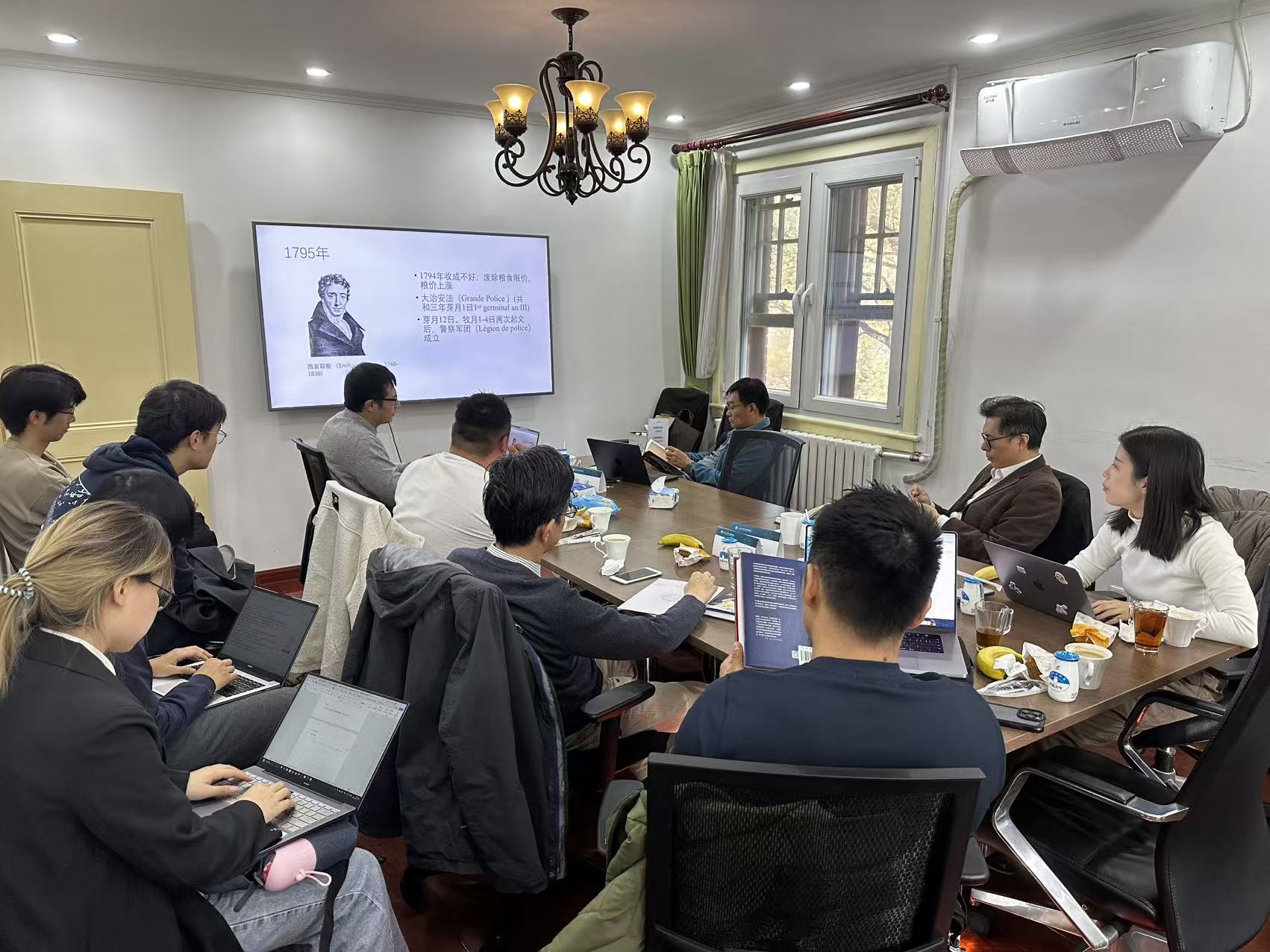
The 17th lecture in the Youth Salon series hosted by the Institute of Area Studies, Peking University (PKUIAS), was held on November 14, 2025. The key speaker was Li Weiyi, assistant research fellow at the Department of History, Peking University. Zan Tao, deputy director of PKUIAS and professor at the Department of History, Peking University moderated the event. The discussion panel included Chong Ming, tenured associate professor at the Department of History, Peking University; Zhang Yongle, deputy director of PKUIAS and tenured associate professor at the School of Law, Peking University; and Liu Yuchen, assistant professor at the School of Government, Peking University.
In the salon, Li Weiyi provided a detailed chronological account of the militarization of policing in Paris during the Directoire exécutif period (1795–1799) and explored efforts to establish republican order in the post-Revolutionary period through the consolidation of public security. He began by introducing the initial attempts to establish a policing order in Paris during the early stages of the Revolution. Under the Ancien Régime, Paris had a relatively loose and chaotic policing system. Following the Revolution, a National Guard was established in Paris, and its reliability was enhanced by recruiting active citizens. However, as the political situation grew increasingly turbulent, there was an urgent need to expand the National Guard’s manpower. By the time of the Jacobin period, a large number of sans-culottes had joined the National Guard, transforming it from a policing force into a revolutionary force.
Subsequently, Li analyzed how the militarization of public security started during the Directoire exécutif period. The two popular uprisings that broke out in 1795 served as catalysts for this process. The Thermidorians, recognizing the need for a professional military force, implemented a series of measures, including the establishment of military tribunals, the militarization of command structures, the creation of the 17th Military District (later replaced by the Inland Army), and the formation of a Police Legion.
Li further explored Napoleon Bonaparte’s contributions to Paris’s public security system and its development. After suppressing the 13 Vendémiaire Year IV Uprising (1795), Napoleon was promoted from an artillery officer to commander-in-chief of the Interior Army. Then he implemented a series of public security measures, including reorganizing the national guard and the police legion, appointing officers, formulating daily troop deployments and emergency plans, stationing 4,200 troops within the city, establishing a surveillance office, and constructing barracks.
In 1796, the Babeuf Plot prompted the dissolution of the police legion, with regular army units taking over its public security duties. Following the Coup of 18 Fructidor, Year V (1797), the political status of regular army forces in Paris further ascended. At the end of 1798, the new commander, Joseph Gillot, divided Paris into four operational zones to facilitate the timely detection and suppression of uprisings.
Li emphasized that the end of the Directoire exécutif was not triggered by lower-class public security issues but was the result of upper-class political turmoil. The coup attempts by figures such as Sieyès coincided with the movement of Parisian regular armies and frontline troops. From the perspective of military-police history, the Parisian public security apparatus—a double-edged sword—became the tool and foundation for Napoleon’s Coup of 18–19 Brumaire (November 9–10, 1799).
In the end of his lecture, Li pointed out that his study focused on the Directoire exécutif period, which has received relatively little attention in the historiography of the French Revolution, filling a gap in the military history of the Revolution regarding the role of the army in maintaining order in the capital. He also argued that the separation between the military and police in public security was not a linear process. Throughout the 19th century, the army continued to play a significant role in Parisian public security. Moreover, Michel Foucault’s two models of “disciplinary city” and “security city” are not mutually exclusive, but coexist.
In the discussion session, Zan Tao first pointed out that the separation of police power and military power could be regarded as part of modernization, and raised the question of whether there are differences between a “French model” and a “British model” in terms of public security.
Chong Ming further elaborated on the evolutionary trajectory of the militarization of public security during the Directoire exécutif period, emphasizing that this research helps us gain a deeper understanding of the internal logic of the French Revolution.
Zhang Yongle explored the conceptual ambiguity between police power and military power during the French Revolution and discussed its connection to the ideological legacy of the Roman Republic.
Liu Yuchen focused on the differences between formal and informal institutions in public security and examined the interaction between the militarization of public security and classic concepts in political science. Li responded to the above concerns and answered their questions.
