

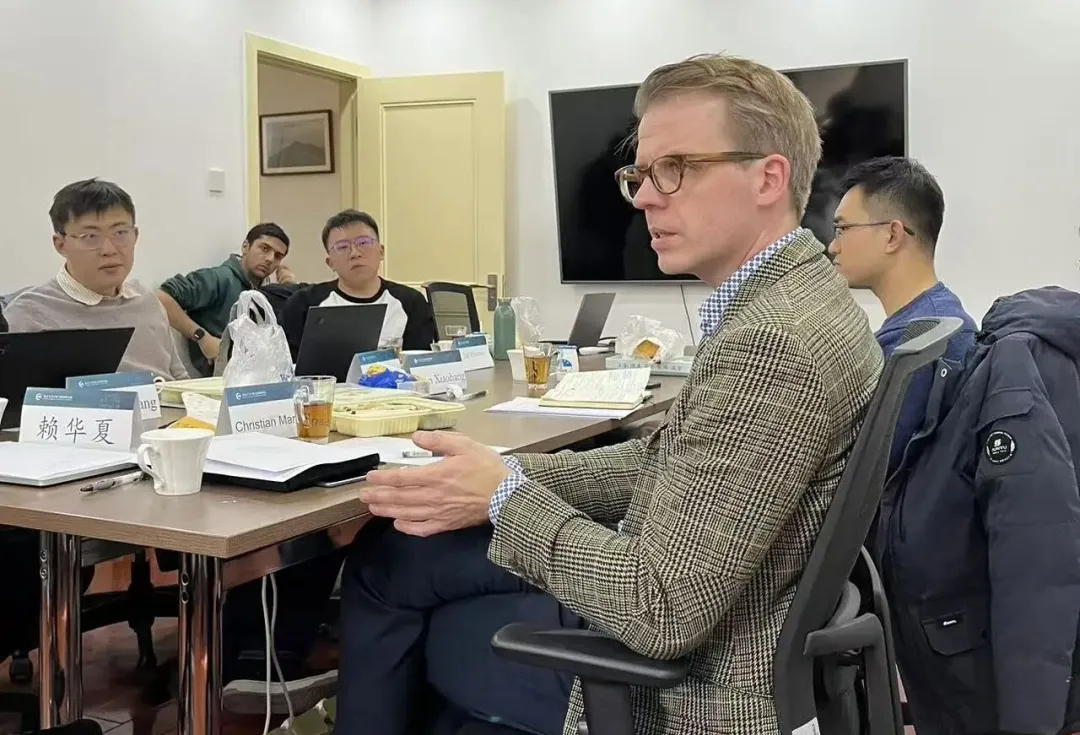
The 67th lecture in the “Adventus Amicorum” series of Peking University’s Institute of Area Studies (PKUIAS) was held on November 11, 2025. With the theme “Reexamining the Concept of Großraumordnung and the Evolution of the Contemporary Global Order,” the seminar invited Prof. Christian Marxsen, director of the Department of Public Law and International Law at Humboldt-Universität zu Berlin, to deliver a keynote speech. The seminar was hosted by Lai Huaxia, assistant professor at the School of International Studies, Peking University. The discussants—all from PKU—included Chen Xiaohang and Wu Xunxiang, both assistant professors at the Law School; and postdoctoral research fellows Lin Zhaoran and Li Pai from the Law School and PKUIAS, respectively. Many teachers and students from inside and outside PKU also attended the seminar.
Prof. Marxsen first explained how he came to research the theme of Großraumordnung. He pointed out that in recent years, when academic and policy circles discuss multi-polar order, regulatory power, and the politicization of international law, citations of Carl Schmitt’s relevant thoughts have increased significantly, and the concept of Großraum (‘great space’) has re-entered public debates. At the same time, emerging regional regulatory claims beyond the traditional sovereign state framework in contemporary state practices have made the possibility that Großraum is being re-consolidated into rules at the international law level a controversial issue. This trend prompted him to rethink the relationship between the concept of Großraumordnung and current changes in the global power structure from the perspective of international law.
When discussing the territorial principle in international law, Prof. Marxsen traced the historical context of territorial integrity as a core concept of modern international law. Ever since the Peace of Westphalia in 1648 laid the basic structure of state-territory-sovereignty, this principle has remained stable for a long time and was further restricted through the principle of national self-determination after the dissolution of the colonial system. However, Marxsen pointed out that during the Cold War, the political logic of the spheres of influence of major powers challenged this international legal structure in various ways. Whether it was the Soviet Union’s “Brezhnev Doctrine”, the US’s interventionist principles established through the “Monroe Doctrine” in the Western Hemisphere, or the academic theory of vital defense areas that emerged at one point, all attempted to legitimize transnational intervention or regional control by major powers. Nevertheless, these claims never truly transformed into established international legal rules, and the principle of sovereign equality enshrined in the UN Charter has maintained strong resilience.
Turning to Schmitt’s concept of Großraum, Prof. Marxsen pointed out that in the 1930s, Schmitt proposed the idea of reconstructing the international order based on the unit of region-hegemonic power, emphasizing that the world should be divided into Großräume (‘great spaces’) dominated by hegemonic forces, and external powers should not interfere in their internal affairs. Historically, this thought was once used by Nazi Germany to provide legal justification for its expansionist policies, but its core logic of replacing universalist international law with regional hegemony resonates in certain political discourses today. He reminded his audience that although Schmitt’s ideas are highly controversial due to his historical background and political stance, his framework regarding spatial order and the relationship between law and geopolitics is being reactivated in some state practices and academic discussions.
Combining his analysis with contemporary developments, Prof. Marxsen focused on analyzing the recent loosening trend of territorial norms in international law, including the relativization of the ban on annexation and the proliferation of practices such as states establishing long-term safe zones and buffer zones in the territories of other countries. Taking examples such as Israel’s policies in the Golan Heights and the West Bank, Russia’s actions in Crimea and eastern Ukraine, and Turkey’s safe zone practices in Syria and Iraq, he pointed out that these phenomena all reflect the tendency of states to seek broader control beyond the traditional sovereign framework. At the same time, he mentioned President Trump’s recent remarks on regaining control of the Panama Canal and Russia’s proposal regarding a wider Russian world, which indicate that expansionist thinking on territorial and influence issues has heated up again globally. Although these practices have not yet constituted a formal change in international law, their cumulative effect may weaken the stability of territorial norms.
At the end of his presentation, Prof. Marxsen returned to his initial question: Is the expansionist thought of Schmittian Großraumordnung entering international law? He noted that the international legal system still possesses significant resilience, most countries still adhere to the principle of sovereign equality, and it is unlikely that the rules will be fundamentally rewritten in the short term. However, the drastic changes in the global power structure, the crisis of trust in the international order, and the convergence of major powers’ policies in certain aspects may indeed provide fertile ground for Großraum-style practices. He quoted the warning from the UN Secretary-General in 2019—that the world is at risk of being “split into competing Großräume”— to emphasize that this trend deserves serious attention.
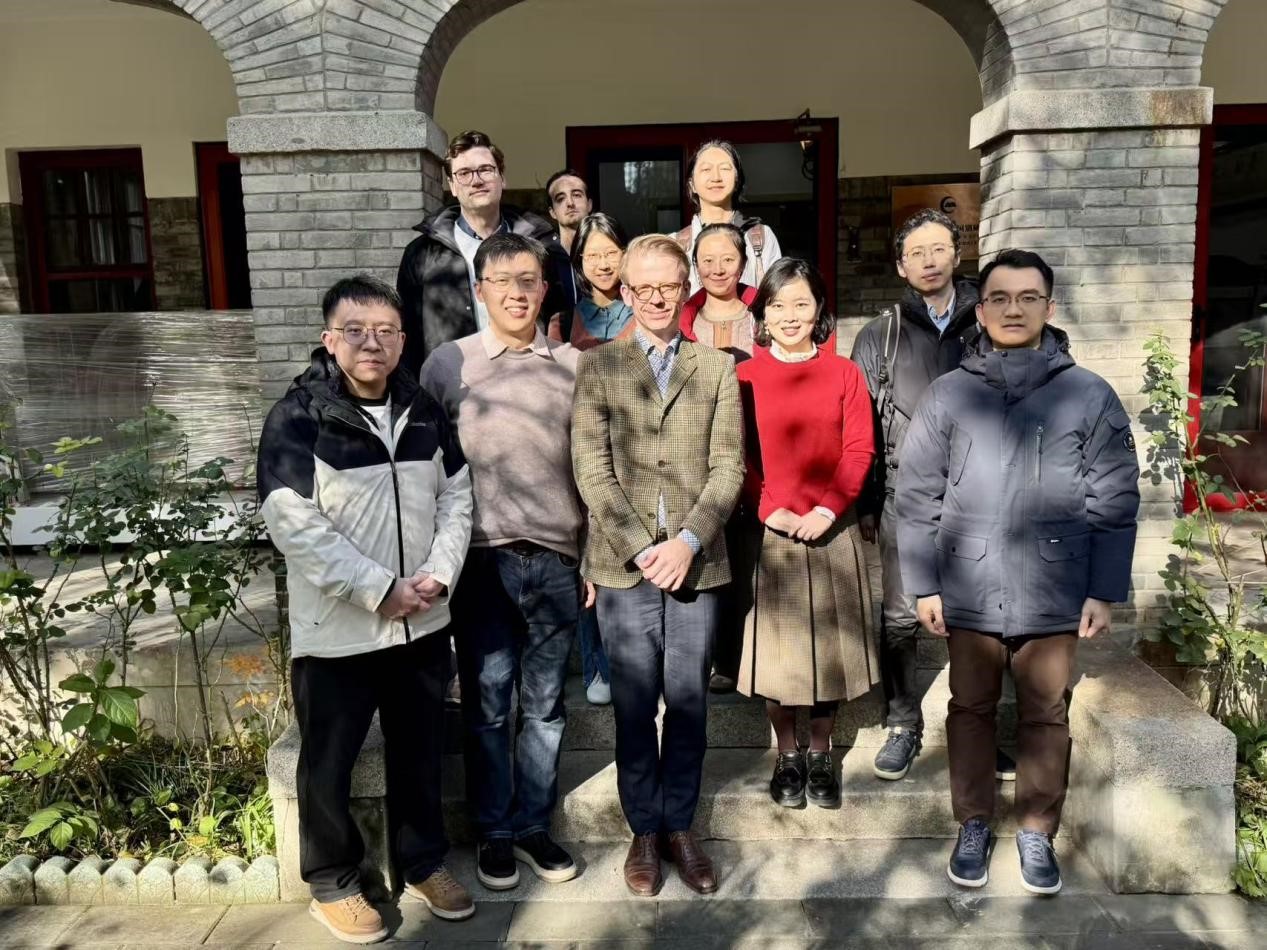
In the subsequent discussion session, scholars conducted in-depth discussions on issues such as the contemporary applicability of Schmitt’ds thoughts, the resilience of the sovereignty principle in international law, the comparative perspective between the Cold War and the present, and how state practices influence the formation of international law.
